
Marketing tactics


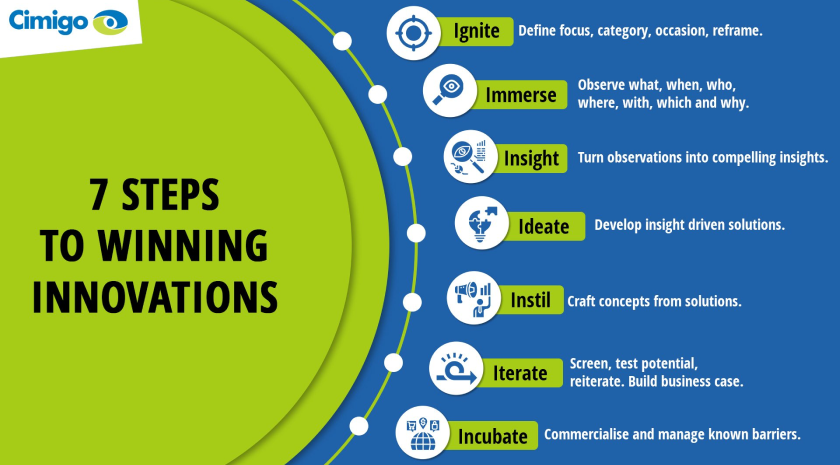
 7 steps to winning innovations
- Concept writing guide
- Concept development
- Rapid concept screening
- Concept testing
- Predicted volume, value and source of business
- Product tests
- Synaesthesia
- Pack development
- Pack tests
- Pack tests with eye tracking
- Right price for consumers’ brand equity
- Simple price sensitivity test
- Complex price optimiser
- Advertising development
- Advertising tests
- Advertising tests with emotional engagement
Cimigo provides market research across innovation and new product development (NPD), concept, product, pack, price, advertising and route to market, helping you make better-informed marketing tactic decisions.
Innovation and new product development (NPD) market research
Innovation: new product development
Cimigo will help you make better choices when developing new products and services which will win in the market. Cimigo will help you make better choices throughout the process from conceptualisation to market delivery.
Cimigo are fortunate to be in fast growing and innovation led markets, where innovation often leapfrogs years of evolution that businesses and consumers will have experienced in developed markets. Most people in Vietnam and Indonesia have never used a fixed line telephone but all spend far too long every day on a smart phone. Many have skipped over credit cards and use mobile wallets.
This has provided Cimigo’s team ample opportunities to guide their client across all categories in the development of new products and services. A minority are truly innovative, the majority are evolutions and adaptions to local cultures, rituals and tastes.
Cimigo have built innovation programmes to ensure the correct processes maintain innovation pipelines. Cimigo’s preferred approach has been built by Cimigo’s founder Richard Burrage encompassing 30 years of experience and over 100 successful innovation launches where products and services are still generating revenue for Cimigo’s clients.
7 steps to winning innovations
Concept development and testing
Concept writing guide
Concept writing, development and iteration is an integral part of new product development and advertising development. Distilling concepts to make them simple is the hardest part of concept writing. The closer to real communication and the more grounded in reality the better. A clear and single-minded concept prevents exposing verbose boring stimulus which only serves to frustrate participants (your target consumers).
It is not possible to realistically communicate your brand architecture through in market communications. A thorough verbose concept may test well (becomes hard to argue with the rationale your concept promotes) but fails to reflect your in-market reality to communicate.
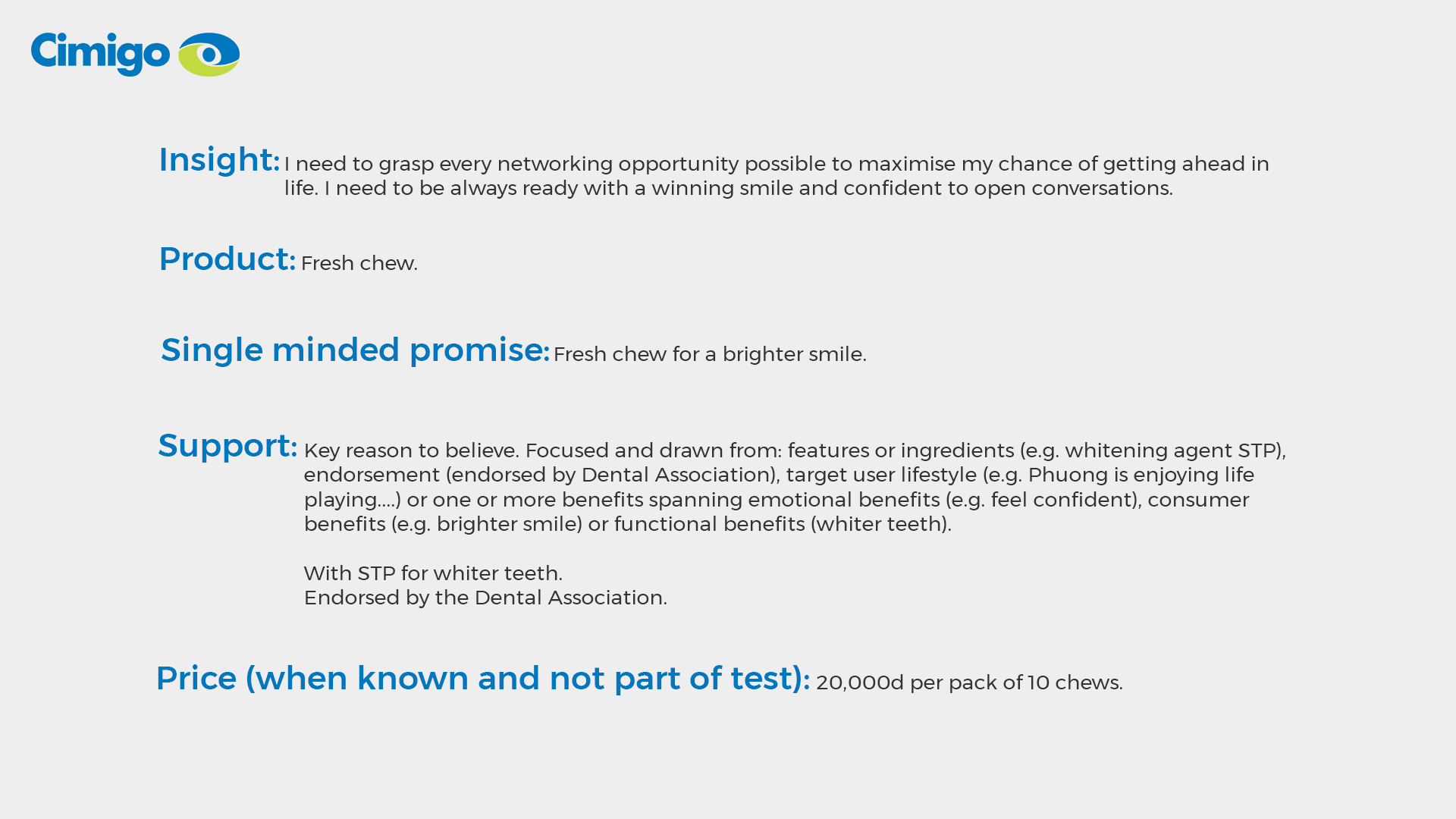
The best concepts are simple and consist of:
Concept development
Concept development is iterative to optimise product ideas for your target groups. It typically involves exposing several concepts amongst focus groups with the target group participants. These may be different product ideas or the same product with a different benefit focus; emotional, consumer of functional benefits. Exposing concepts which are directionally different in their proposition and the key supporting benefits helps learn at what level it is necessary to communicate.
For example
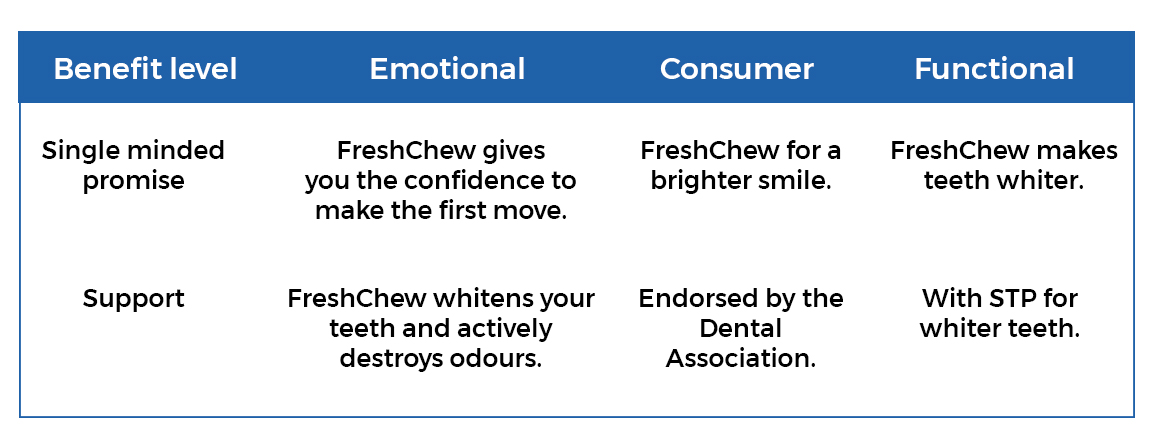
This helps to unveil which resonate with the consumer and which do not. It helps the moderator to facilitate the participants to optimise the concept, to that which will be the most compelling. Note that the learning from what does not work well, is often the most insightful.
After each focus group discussion, the Cimigo and your team will reconvene to summarise learning’s from the group to allow for refinement and optimisation of the concepts with the objective of having the final proposition messaging at the end of all the group discussions.
The discussion is moderated to provide the target group’s perspective on;
Understand the decision and shopping journey;
- Consideration of products.
- Motivations and barrier towards brands.
- Drivers of brand choice.
- Touch points and the influencers.
Iterative concept development to explore;
- Spontaneous reactions.
- Concept insight (truth, relevance and attraction) ability to impact behaviour.
- Concept benefits and reason to believe.
- Brand name reactions and associations.
- Comprehension and message taken out.
- Relevance.
- Differentiation.
- Credibility.
- Appeal and interest.
- Price and source of business.
Cimigo will help you make better decisions on how to optimise the concept for your target group and help you to determine which to drop and which may have potential to be re-cycled either at a later date or for another target group.
Rapid concept screening
Often there are too many ideas seeking resources and development in Cimigo’s client’s innovation funnels. The ideas may have been developed from the bottom up, following the innovation process. Alternatively, they may be ideas that the client has launched successfully in one country and wish to explore the potential in another.
To help screen and focus on concepts with the best potential, Cimigo will quantitatively screen concepts rapidly, to help make better choices and enable resources to be focused on the best opportunity.
Rapid concept screening offers these advantages:
- Quick and easy to administer.
- Screening of many ideas.
- Learn concept potential immediately.
- Rank prediction of best volume opportunity.
- Any stimulus – concept, print ad, videomatic may be used.
- Filter to ideas to proceed with quickly.
This service is available as a self-service RapidSurvey solution or Cimigo can support you with a customised service.
The results rank concept’s by:
- Best volume opportunity.
- Most appealing concept.
- Interest score, buy score and success score.
Concept testing
Validating concepts quantitatively is an integral part of Cimigo’s new product development service. Testing an optimised concept involves validating;
-

Appeal. -

Optimal price. -

Name. -

Pack design. -

Relevance. -

Source of business. -

Pricing. -

Uniqueness.
Providing meaningful volume and value forecasts to asses commercial viability requires that Cimigo crack the code of individual buying decisions. Whilst most market modelling merely aggerate the crowd (i.e. all participants to the survey) using overall metrics, Cimigo analyse each individual’s purchase decision. Cimigo then set a validated but tough minimum benchmark for each participant in this concept test survey.
Cimigo’s approach requires that the survey participant response to the concept must be positive on all aspects evaluated. For example, if the pack is not appealing, yet all other factors are, Cimigo recognise that this will not result in a buy decision for this individual. Therefore, even though the overall appeal may be positive, Cimigo do not account for this individual in the volume and value forecasts. It is a tough standard by which to be judged, but produces sales forecasts that have been proven time and time again.
Cimigo’s approach recognises that not all individuals are open to change and also takes into account the individual’s historic engagement with the brand and variant in question. The key metrics that enable Cimigo to make accurate forecasts of commercial success are;
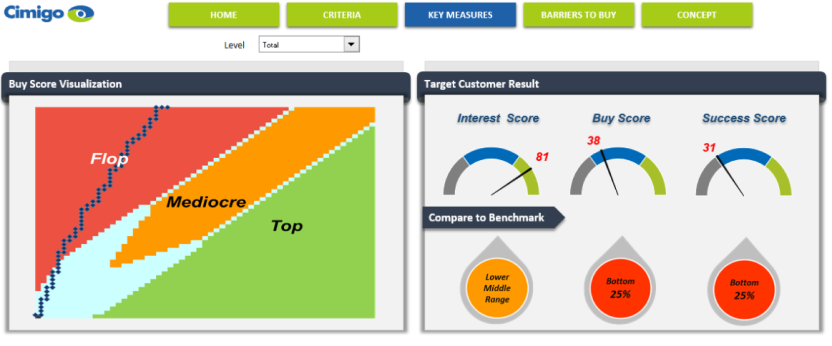
Interest score
It is accepted that not all consumers will be interested to try. This measure assesses the interest to try based on the concept exposed.
Buy score
In order to buy consumers must not reject any key aspect of the concept. If they reject just one it is unlikely that they will buy. The buy score includes all consumers who are positive to all aspects. The key aspects are: overall appealing, promise relevance, claim relevance, uniqueness, design appeal, name appeal and price for pack shown.
Success score
Determines a buying percentage when launching product. Cimigo can predict success and more importantly where concepts will flop.
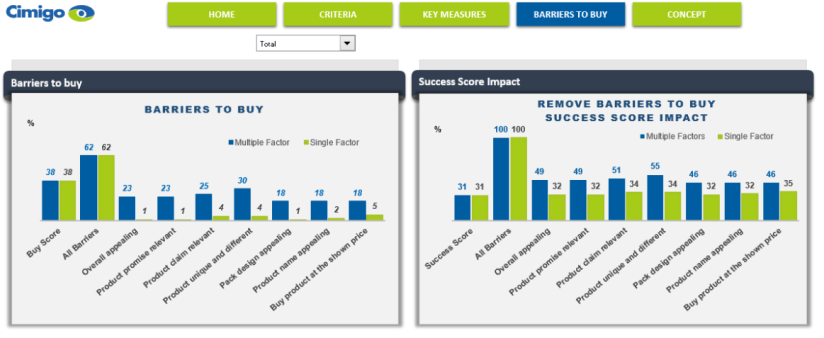
Cimigo can diagnose the barriers to buy and guide improvements and diagnose the impact of successfully overcoming barriers.
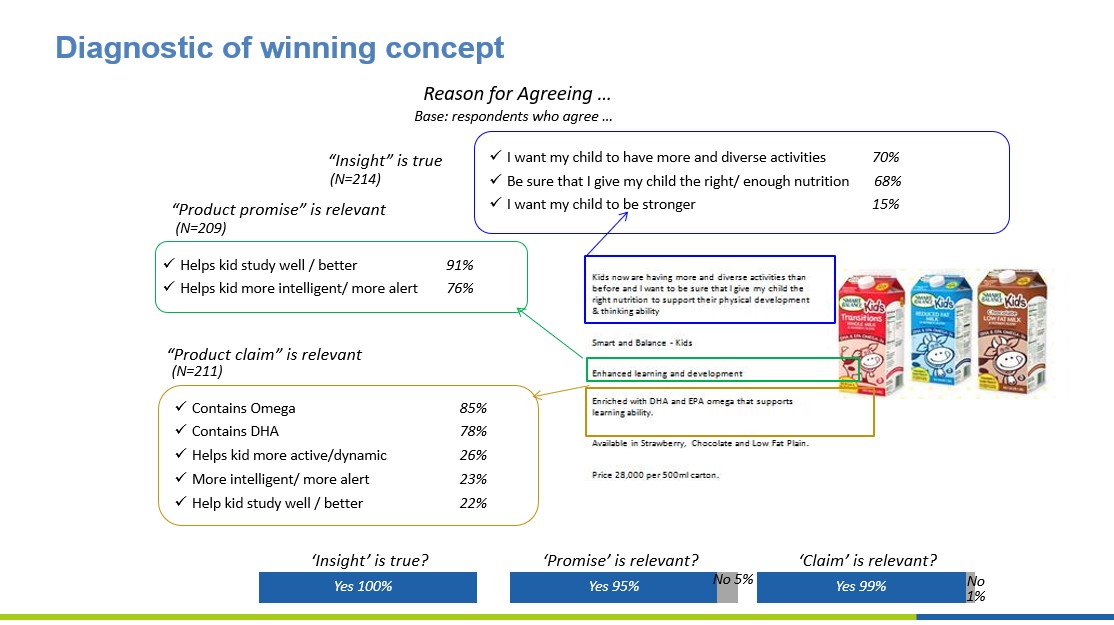
Diagnostics help Cimigo advise you better choices within your concept, what to highlight and what to change.
Predicted volume, value and source of business
Cimigo will use the concept test results to predict volume, value and source of business (including cannibalisation). To do so Cimigo use three further data points (or multiple scenarios thereof in a simulator) which link back to commercial and marketing planning. Specifically:
- Target weighted distribution.
- Target awareness.
- Current volume shares.
Combined this analysis enables to determine key commercial forecasts in accordance with launch planning time frames and the aforementioned targets.
- Penetration.
- Annual volumes (before and after own portfolio cannibalisation).
- Annual values of retail sales (before and after own portfolio cannibalisation).
- Retail share of sales.
This provides the business case support required to justify commercialisation, enabling the launch and management of known barriers to success.
Product testing
Product tests
Cimigo test products every week, some new, some evolutions and some just to ensure Cimigo’s clients are out performing their competitors. There is a plethora of approaches to test products depending on the decisions you need to make. Cimigo will help you make better choices depending on the decisions in hand.
Most commonly products are tested against the current product or competitive products or several alternative options for new products. This enables a benchmarking comparison. This is typically managed by matching panels of participants or testing on a rotated basis, one after the other (sequential monadic design).
In home use test
Whether it be for a washing detergent, a beauty regime, a children’s milk or a rice cooker, Cimigo will recruit the target consumers in the identified segment to use the product at home. These participants will put aside their ‘usual’ product and use and evaluate your product, providing feedback with video, images and answers to questions on Cimigo’s mobile application after (and often during) their use.
In home use tests are critical in many categories where experience can change with continued use, through saturation, boredom or different occasions of use.
Central location tests
Typically employed for sensory testing, be that; apples, rice, sauces, beverages, candies, motorbikes or cars. Cimigo will recruit the target consumers in the identified segment to visit Cimigo’s in-house testing facilities where in a controlled environment (de-branding and consistent; testing protocols, temperatures, serving equipment, stimulus exposure, processes, etc.) they can test the product and Cimigo can collate feedback from interviews and in-depth interviews.
Synaesthesia
The senses are critical to branding, by focusing on synaesthesia, the multi-sensory experience, you can heighten the brand’s appeal and differentiation. Synaesthesia brings together the science of sensory perception. So many products permeate eight senses
-

Sight -

Hearing -

Touch -

Taste -

Smell -

Kinaesthesia (derived from consumer posture and movement) -

Temperature -

Pain
They interact with one another – some more than others. I look at my laundry, smell it, feel it with my fingers and brush it across my face! I do so when I open the package, when I wring out my clothes, when I hang them to dry and when I iron and fold them.
Consumers struggle to articulate and describe their sensory experience. Consumer language is especially naïve, subjective, limited and variable in describing the senses. Specialist synaesthesia techniques can provide rich consumer diagnostics to fuel development process and helps consumers articulate the sensory experience, the gaps and desires.
Cimigo help elicit the unconscious as consumers are often unaware of their sensory experiences. Synaesthesia projective and elicitation techniques are numerous, some examples:
- Sensory audit.
- Video sequencing.
- Magnifying.
- Cross sensory probing.
- Cross sensory stimuli.
- Metaphors.
Pack testing
Cimigo’s pack testing research helps organisations compare packaging concepts before launch, identifying which design attracts attention, communicates the intended proposition and is most likely to drive purchase. Packaging is often the most influential marketing asset a consumer encounters. It competes directly with rival brands on the shelf, communicates your brand proposition in seconds, and continues to build brand recognition long after advertising has been forgotten.
Whether you are launching a new product, refreshing an established brand or extending an existing product range, pack testing reduces development risk and provides evidence-based recommendations before significant investment is committed.
What is a pack test?
A pack test is a structured consumer research study that evaluates alternative packaging designs before launch. Rather than relying on internal opinion or design preference, target consumers compare packaging concepts in realistic purchase situations, allowing organisations to understand which design performs best and why. A Cimigo pack test measures:
- Shelf visibility.
- Brand recognition.
- Communication of key messages.
- Purchase intention.
- Product differentiation.
- Premium perception.
- Variant navigation.
- Overall preference.
The result is a packaging design that has been validated with consumers before production begins. Typical pack test study
- Up to 4 packaging concepts.
- Approximately 200 target consumers.
- Interactive online dashboard.
- Results in approximately 10 working days.
- Typical investment: US$2,549 (approximately VND65 million).
- Optional eye tracking.
Why conduct a pack test?
Packaging decisions influence every stage of the customer journey. A successful pack must:
- Capture attention quickly.
- Reinforce distinctive brand assets.
- Communicate the product proposition.
- Differentiate variants.
- Support pricing strategy.
- Build trust.
- Encourage purchase.
Small changes in colour, imagery, typography, structure or information hierarchy can significantly influence consumer behaviour. Testing packaging before launch helps reduce uncertainty and improves confidence in important commercial decisions.
Cimigo insight
Packaging is your most persistent marketing medium. Every unit sold carries your brand into retail environments, consumers’ homes and everyday usage occasions. Unlike advertising campaigns, packaging continues building brand equity throughout the product’s life.The Cimigo packaging performance framework
Successful packaging is more than attractive design. It must perform across multiple dimensions simultaneously. A package may attract attention but fail to communicate its proposition. It may communicate well but create confusion between product variants. It may encourage first purchase but fail to reinforce confidence after use.
At Cimigo, we don’t simply report research metrics. We interpret how packaging performs against five commercial dimensions that influence consumer choice and long-term brand performance.
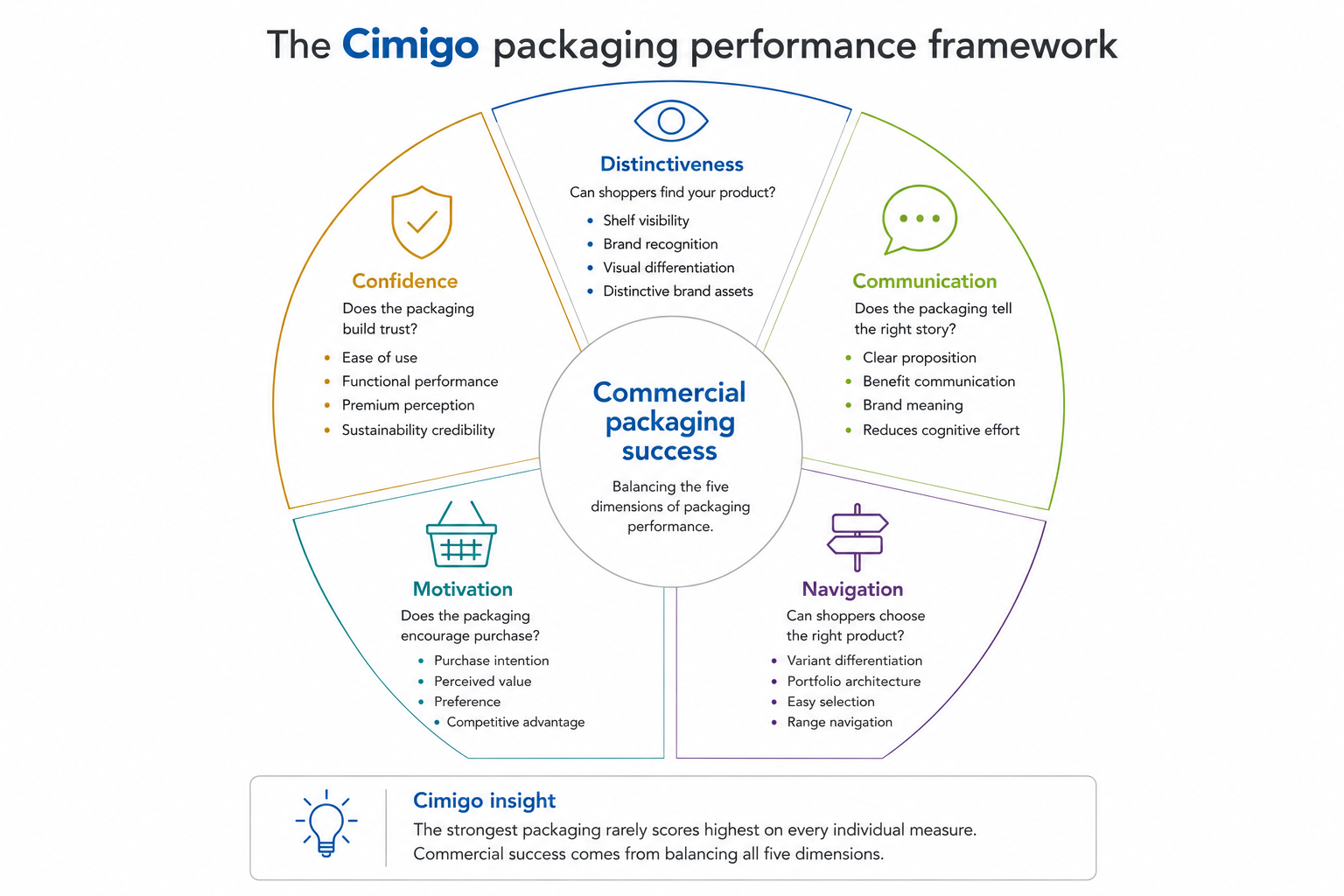
1. Distinctiveness: Can shoppers find your product?
The first challenge is attracting attention within a crowded retail environment. Packaging must stand out against competing brands while reinforcing your distinctive brand assets. We evaluate:
- Shelf visibility.
- Brand recognition.
- Visual differentiation.
- Recall of key brand assets.
A package that cannot be found cannot be chosen.
2. Communication: Does the packaging tell the right story?
Consumers often spend only one or two seconds evaluating packaging. During that brief moment, the pack must communicate what the product is, why it matters and why it deserves consideration. We assess whether consumers correctly interpret the intended positioning, including quality, efficacy, naturalness, premium credentials, convenience and sustainability. Good packaging reduces cognitive effort by communicating clearly and quickly.
3. Navigation: Can shoppers make the right choice?
Modern brands often have extensive portfolios across flavours, formats, sizes and price tiers. Packaging should help shoppers navigate these choices without confusion. We evaluate:
- Variant differentiation.
- Product hierarchy.
- Portfolio architecture.
- Ease of product selection.
Effective navigation reduces purchase errors and improves the shopping experience.
4. Motivation: Does the packaging encourage purchase?
Packaging should do more than communicate. It should motivate action. We assess:
- Purchase intention
- Perceived value
- Overall preference
- Competitive advantage
Just as importantly, we identify why one design motivates purchase more effectively than another.
5. Confidence: Does the packaging reinforce trust after purchase?
The role of packaging continues after the product leaves the shelf. It should reinforce quality, support usability and strengthen confidence in the brand throughout the ownership experience. Depending on the category, we evaluate:
- Ease of opening and dispensing.
- Functional performance.
- Premium perception.
- Sustainability credibility.
- Overall confidence in the product.
Packaging that builds confidence today contributes to repeat purchase tomorrow.
Cimigo insight
Most research companies report pack test scores. Cimigo interprets what those scores mean for commercial performance and translates them into practical packaging recommendations. The strongest packaging rarely scores highest on every individual measure. Success comes from achieving the right balance between Distinctiveness, Communication, Navigation, Motivation and Confidence. Our consultants identify that balance and provide practical recommendations to optimise packaging before production begins.Cimigo pack testing approach
Every study is tailored to the commercial objectives of the client, category and market. 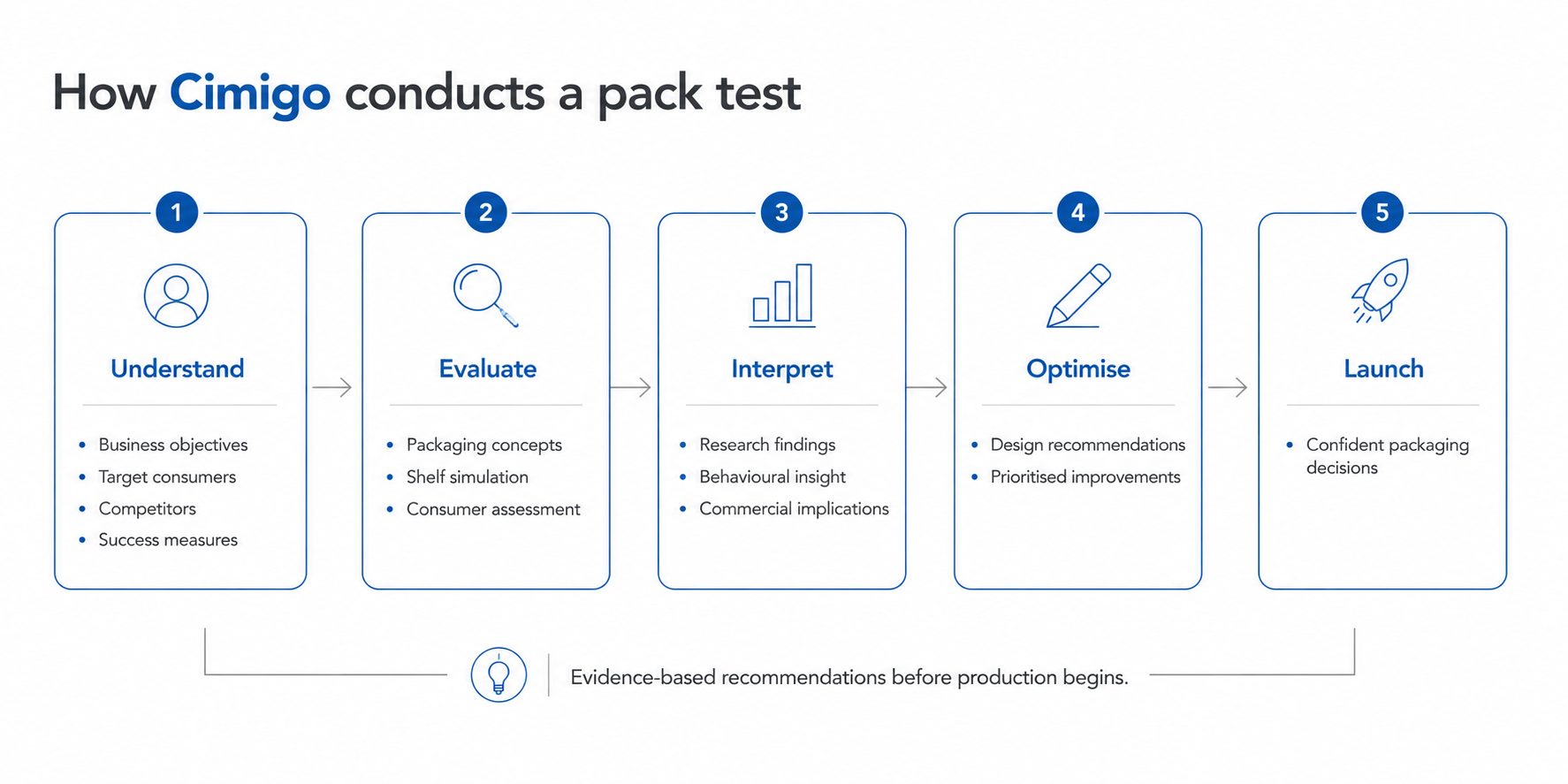
Define the objectives
We begin by understanding:
- Your business challenge.
- Target consumers.
- Competitive landscape.
- Success criteria.
Evaluate packaging concepts
Consumers compare up to four packaging concepts, individually and within competitive shelf environments where appropriate. Benchmarking against competitor packaging provides valuable commercial context.
Simple quantitative pack tests often compare new designs with current designs to determine preference. They are typically tested on a rotated basis, one after the other (sequential monadic design) before being compared side by side.
Cimigo’s pack testing service is available as a self-service RapidSurvey solution. Cimigo can also support you with a customised research service.
Analyse consumer response
Our consultants evaluate each concept across multiple performance measures and identify the reasons behind consumer preferences. Rather than simply reporting scores, we explain what the results mean for your packaging strategy.
Optimise before launch
The research concludes with practical recommendations covering:
- Visual hierarchy.
- Brand assets.
- Message communication.
- Variant architecture.
- Design improvements.
This allows packaging to be refined before artwork is finalised and production begins.
Eye tracking for pack testing
Traditional pack testing tells you what consumers say. Eye tracking shows what they actually see. Using realistic virtual shelf environments, eye tracking measures how shoppers visually interact with packaging before making purchase decisions. Metrics include:
- First fixation.
- Time to first notice.
- Gaze duration.
- Heat maps.
- Areas of visual attention.
- Comparison with competing brands.
Behavioural evidence complements survey responses and helps optimise packaging for maximum shelf impact.
Pack tests with eye tracking
Eye tracking is often deployed in addition to survey questions. This helps Cimigo to determine the impact the pack has on shoppers in store and on the shelf. Occasionally this uses a mock store environment, but this setup is prohibitively expensive for many clients. Eye tracking technology is often a virtual solution that can be conducted with the target group online.
Typically, packs including competitors are shown on virtual shelf so that Cimigo can learn how shoppers scan their shopping environment and just what grabs attention. The ability to gauge exactly what is looked at, for how long and in what order enables Cimigo to help you make better decisions on which pack option to pursue and how best to optimise it.
Cimigo’s pack testing service is available as a self-service RapidSurvey solution. Cimigo can also support you with a customised research service.
Eye tracking enables Cimigo to determine;
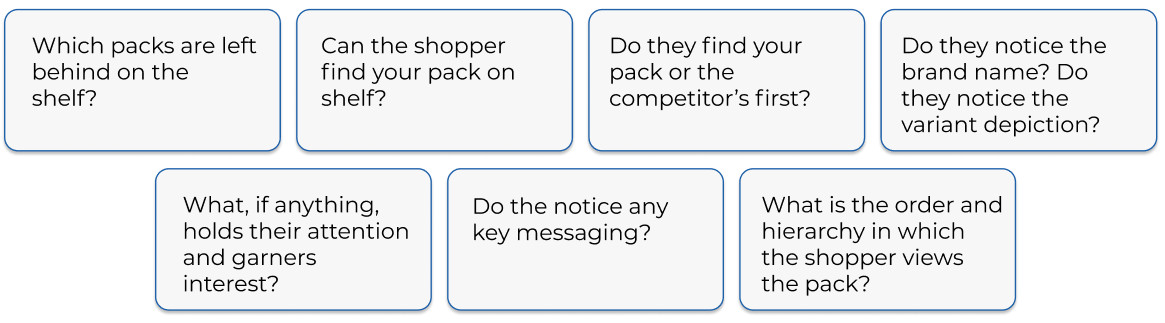
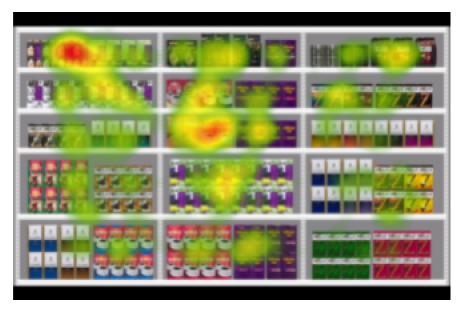
Quantitative metrics allow Cimigo to identify which packaging is attracting first gaze and length of gaze to determine which attract attention and hold attention.
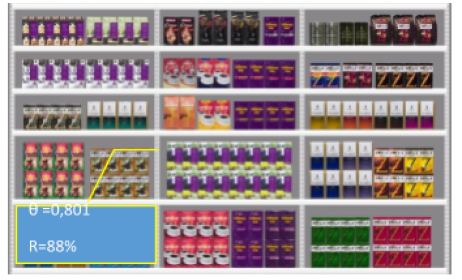
With eye tracking Cimigo can identify what in the range is actually looked at and in what concentration. Using “fixations” (i.e. when a consumer focuses) Cimigo have clear metrics on the speed at which a product is found; the extent to which it is focused on; and whether respondents come back to look at the product again. All of these metrics mean Cimigo can identify the effectiveness of a product standing out and therefore its ability to capture the attention of consumers.
In this Clear Asahi beer example, the gaze movement from mid-to-upper; indicates viewing of the brand logo and beer bubbles logo motif in the centre which includes a brand message. Fixations demonstrate that most time is spent on the brewer’s name ahead of the brand variant.
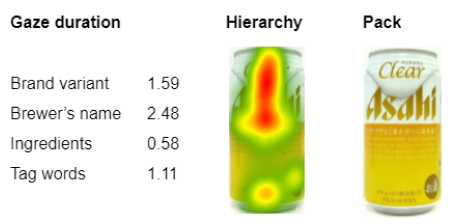
At the individual pack-level, Cimigo can also determine key messaging, hierarchy and fixations. Hence Cimigo can determine in what order and for how long respondents spend on key elements of the packaging. This enables Cimigo to determine whether respondents are spending time (and seeing) key communication elements or whether they are confused or spending time on elements that are not helpful in increasing understanding of the brand and its features.
Comparing across pack designs enables Cimigo to help you make better choices and to ensure your pack does not get left behind on the shelf.
Cimigo insight
Consumers rarely analyse packaging element by element. They respond to the overall impression created by colour, typography, imagery, structure and materials working together. Effective pack testing identifies the combination that communicates your intended brand meaning most successfully.Pack testing applications
Pack testing supports organisations throughout the innovation process. Typical applications include:
New product launches
Select the strongest packaging before launch.
Packaging redesign
Modernise packaging while protecting existing brand recognition.
Product line extensions
Help consumers distinguish between flavours, sizes and product variants.
Premiumisation
Evaluate whether packaging supports higher pricing and stronger quality perceptions.
Sustainability initiatives
Test new materials and environmental messaging before implementation.
Seasonal and limited editions
Develop culturally relevant packaging while maintaining long-term brand recognition.
Common reasons packaging redesigns fail
A successful packaging redesign should strengthen brand recognition while improving shopper engagement. However, even well-intentioned redesigns can reduce visibility, confuse consumers or weaken purchase intent if they are not tested before launch.
Changing distinctive brand assets too aggressively
Consumers rely on familiar visual cues to recognise brands quickly on the shelf. Significant changes to logos, colours, typography or pack structure can reduce recognition and make established brands harder to find. Effective redesigns evolve distinctive brand assets rather than replacing them.
Overloading the front of pack
Packaging often has only a few seconds to capture attention. Adding too many claims, messages or design elements can create visual clutter and make it difficult for shoppers to identify the brand, product or key benefit. Clear visual hierarchy is usually more effective than communicating everything at once.
Weak variant differentiation
As product portfolios grow, consumers need to distinguish between flavours, sizes, formulations or benefits quickly. Poor variant architecture can lead to confusion, incorrect product selection or lost sales. Pack testing helps identify whether shoppers can easily navigate the range.
Following design trends instead of shopper behaviour
Contemporary design trends may appeal to internal stakeholders but do not always improve commercial performance. The most successful packaging is based on how consumers notice, interpret and choose products in real shopping environments, rather than aesthetic preferences alone.
Testing too late in the development process
Packaging changes become increasingly expensive once artwork is finalised or production has begun. Testing concepts early allows organisations to refine designs while changes are still practical and cost-effective, reducing the risk of costly redesigns after launch.
Cimigo insight
Many unsuccessful packaging redesigns are not caused by poor design, but by assumptions about how shoppers behave. Pack testing provides objective evidence to help organisations optimise packaging before committing to production.Why choose Cimigo?
Since 2003, Cimigo has helped leading organisations across Vietnam and Indonesia make better innovation decisions through evidence-based consumer research. Our consultants combine quantitative research, qualitative insight and behavioural methodologies with deep understanding of Southeast Asian consumers and retail environments. Clients value Cimigo because we provide:
- Local expertise across Vietnam and Indonesia.
- Independent, evidence-based recommendations.
- Practical commercial advice.
- Interactive dashboards.
- Rapid turnaround.
- Experienced innovation researchers.
Our objective is not simply to identify the preferred packaging design, but to explain why it performs better and how it can be improved further.
Pack testing deliverables
Every pack testing project provides practical outputs designed to support confident decision-making. Deliverables typically include:
- Executive summary.
- Packaging performance scorecards.
- Ranking of concepts.
- Purchase intention analysis.
- Brand communication assessment.
- Consumer verbatim comments.
- Design recommendations.
- Interactive dashboard.
Optional eye tracking provides additional behavioural analysis through visual attention heat maps and gaze metrics.
Pack testing timing and investment
Our standard pack testing solution includes:
- Up to 4 packaging concepts.
- Approximately 200 target consumers.
- Interactive online dashboard.
- Results in approximately 10 working days.
- Typical investment: US$2,549 (approximately VND65 million).
- Optional eye tracking. Additional US$1,080 (approximately VND27.5 million).
Please contact us for customised methodologies, larger sample sizes or multi-country studies.
Frequently asked questions
What is a pack test?
A pack test compares alternative packaging designs with target consumers to identify which concept performs best before launch.
When should packaging be tested?
Ideally before artwork is finalised and before production tooling begins, when changes remain relatively inexpensive.
Should I test packaging before product testing?
It depends on the stage of development and the decision you need to make. If both the product and packaging are still evolving, we generally recommend testing the product first to ensure it meets consumer expectations. Once the product concept is validated, pack testing helps identify the packaging design that best communicates the product’s benefits and encourages purchase.
For products where packaging plays a major role in consumer choice, such as FMCG, beverages, personal care and healthcare, pack testing is often conducted alongside or immediately after product testing as part of an integrated innovation programme.
How many pack concepts should be included?
Most pack testing studies compare between two and four packaging concepts. Testing too few concepts may limit learning, while testing too many can increase respondent fatigue and reduce the quality of feedback.
We generally recommend evaluating up to four concepts, together with relevant competitor packaging where appropriate. The optimal number depends on your objectives, the maturity of the designs and the decisions the research is intended to support.
Can unfinished packaging concepts be evaluated?
Yes. Digital artwork, mock-ups and early packaging concepts can all be tested during development.
Should competitors be included?
Yes. Competitive benchmarking helps identify opportunities for stronger differentiation and better shelf performance.
Can Cimigo conduct pack tests across multiple countries?
Yes. We regularly conduct comparable pack testing studies across Vietnam, Indonesia and other Southeast Asian markets using consistent methodologies while reflecting local shopping behaviour.
Can eye tracking be added?
Yes. Eye tracking provides objective behavioural evidence showing exactly how shoppers visually engage with packaging in realistic retail environments.
What makes a successful pack test?
A successful pack test goes beyond identifying the preferred design. It explains why one concept performs better and provides clear recommendations for improvement. At Cimigo, we interpret packaging using the Cimigo packaging performance framework, evaluating five dimensions of commercial performance: Distinctiveness, Communication, Navigation, Motivation and Confidence. This helps organisations make informed design decisions rather than simply choosing the highest-scoring concept.
Related innovation solutions
Pack testing is one part of successful product innovation. Related Cimigo solutions include:
- Pack development.
- Pack testing with eye tracking.
- New product development research.
- Concept development and testing.
- Product testing.
- Pricing research.
- Shopper research.
- Route to market research.
Together these solutions support organisations from early innovation through to successful commercial launch.
Talk to a packaging research specialist
Choosing the right packaging is one of the most important decisions in product development. Cimigo’s pack testing solution helps organisations identify the packaging design most likely to succeed before production begins, reducing commercial risk and improving in-market performance. Contact one of our consultants to discuss the most appropriate pack testing approach for your category, market and business objectives.
Price testing
Cimigo can help you make better pricing decisions. The appropriate pricing approach and research solution will depend on the complexity of the decision.
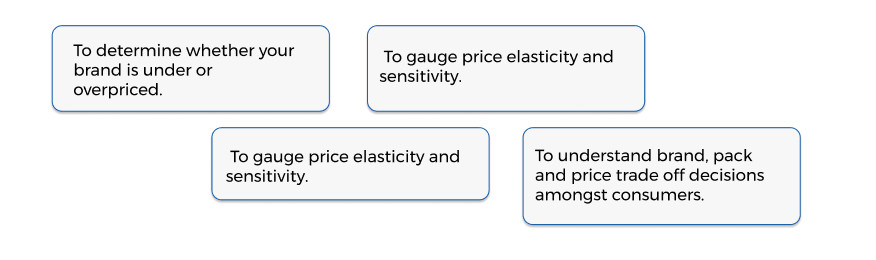
Pricing decisions are important for determining:
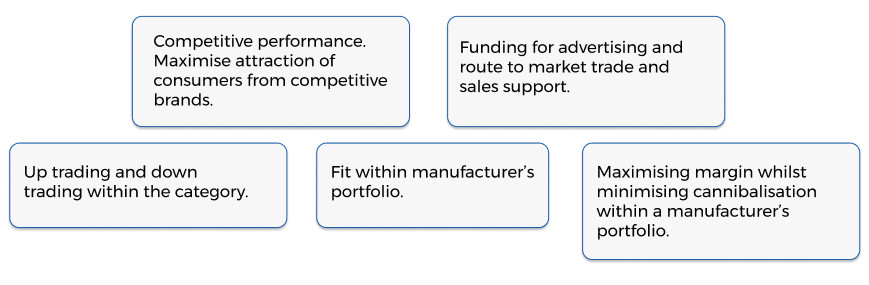
Setting the right price for your brand’s perceived value
How do you know whether you are setting the right price for your product? The chart below is a favourite among CEOs and CFOs. It helps determine whether a brand is priced below or above the value consumers perceive it to offer.
Few brands are overpriced, but many are priced below their potential. A brand may be able to charge more when its products offer values and features that competitors cannot match. Many businesses do not fully recognise the brand equity they have built. Consequently, they miss potential revenue because their products are underpriced.
Cimigo can help you make better decisions by identifying whether your brand is priced above or below its perceived value. Cimigo’s brand value model compares brands within the same product category, identifies the factors that drive purchase behaviour and measures their relationship with current retail prices.
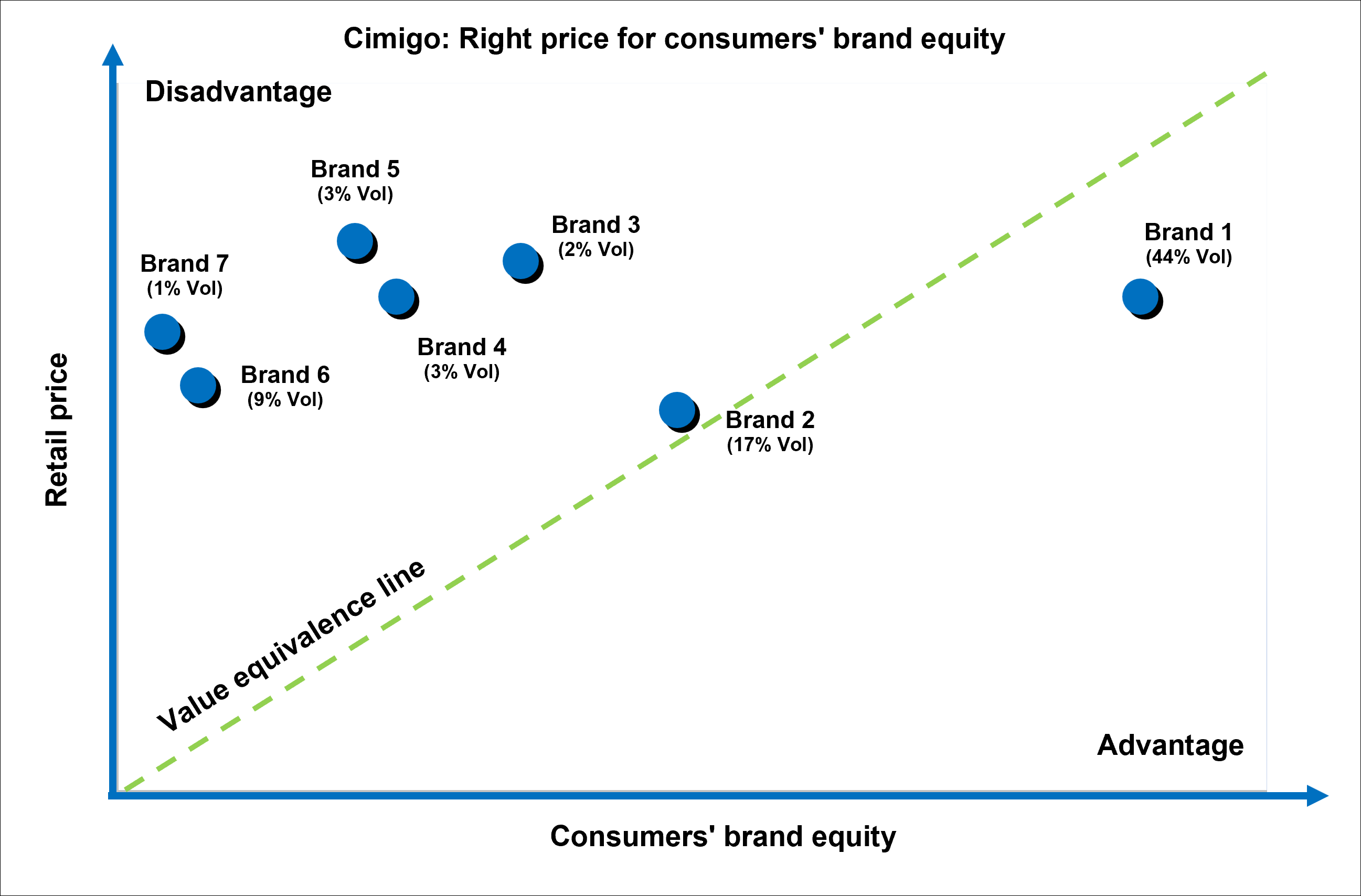
Some brands, such as brand 2 on the map, are appropriately priced for the value they provide to consumers. They therefore sit close to the value equivalence line.
Brand 1 sits in the advantage zone, to the right of the brand value equivalence line. This brand provides more value than consumers are paying for and therefore achieves considerable market share and sales volume. The brand owner should undertake further pricing research to understand the effect of a higher price on market share, volume and margin, and to identify the optimal price point. In this example, further research led to an increase in the price of brand 1. Its volume share fell slightly, but the manufacturer earned more profit.
Brands 3, 4, 5, 6 and 7 sit in the disadvantage zone, to the left of the brand value equivalence line. These brands provide consumers with less value than their prices suggest. They need to identify the factors that influence consumer choice and strengthen their brand value and brand equity. During this process, they should also review their pricing tactics. Several brands in this example have relied on promotions to clear inventory.
Simple price sensitivity assessment
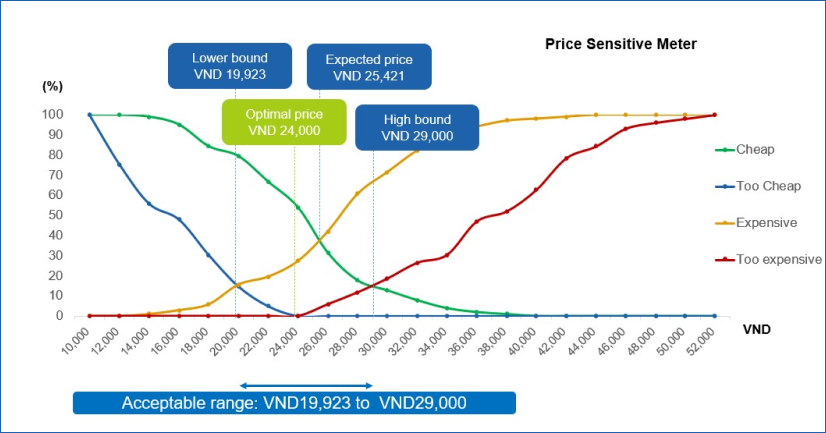
Cimigo applies a simple price sensitivity meter model to determine the acceptable price range and the optimal price within it. Consumers are asked at which price they consider the brand being tested to be:
- Too expensive: At what price would you consider the product so expensive that you would not consider buying it?
- Too cheap: At what price would you consider the product so cheap that you would question its quality?
- Expensive: At what price would you consider the product to be becoming expensive, but would still consider buying it?
- A bargain: At what price would you consider the product a bargain, offering excellent value for money?
In this example, the optimal price is VND 24,000. The acceptable price range is from VND 19,923 to VND 29,000. Beyond this range, too much consumer demand is lost.
Cimigo’s price testing service is available as a self-service RapidSurvey solution. Cimigo can also support you with a customised research service.
Complex price optimiser

A more advanced pricing solution is the Cimigo price optimiser. This approach uses discrete choice modelling to assess how different combinations of selected product attributes, such as brand, pack and price, are likely to affect sales volumes and values.
This approach is best suited to significant or high-risk decisions. It is the most reliable method Cimigo knows for estimating market share, short of undertaking a test market. It simulates actual purchase decisions by asking consumers to make holistic choices between products.
Discrete choice modelling is particularly well suited to portfolio management because numerous brands can be included in the experimental design. It captures interaction effects, making it possible to evaluate price sensitivity by brand. It also estimates volume and value share under different pricing scenarios.
The main benefits of the Cimigo price optimiser over other approaches are:
- Realistic stimuli using actual pack images and prices.
- Realistic consumer tasks that closely simulate purchase decisions through holistic product choices.
- A disguised task using randomisation and a statistically reliable experimental design. Respondents cannot easily determine the purpose of the research because they see no consistent relationship between prices and brands.
- Explicit estimates of market share. Unlike approaches based on rating scales or purchase-intent scores, the discrete choice model produces choice-based outputs.
- Interaction effects are captured, making it possible to evaluate price sensitivity by brand.
Brands, product variants and price ranges are used as inputs to generate choice tasks through a systematic factorial design. Each choice task presents images of brand variants with the relevant price levels displayed.
The variables are combined into different scenarios and presented to target consumers. As one consumer cannot review every scenario, different groups of consumers see different combinations. All consumers see the scenario containing the current product range at current prices. They are then asked to purchase the products their household would require for the next seven days, or another appropriate period.
Cimigo provides an easy-to-use Excel-based simulator that shows the modelled results for any pricing scenario within the scope of the design. Where margin and cost data have been provided to Cimigo, the simulator also includes profitability analysis. This allows profitability to be calculated under different pricing strategies.
Advertising development and testing
Cimigo will help you make better choices from unveiling insights from the first creative ideas through to the evolution and validation of a communication campaign.
Learn more about what just makes advertising work here.
Advertising development

Communications development and iteration can take many forms depending on the creative process. It may begin with alternative big creative ideas, several or just one-story board for video development or key visuals and copy for digital or print publication.
Communications development typically involves exposing the creative ideas amongst focus groups with the target group participants. Communications development is iterative to optimise stories, ensure that the brand cuts through and that the message is delivered effectively. Communications development work can save a great deal of expense or missed opportunity later in both the production process and media expenditure. There is nothing more frustrating for a brand team than learning once invested in media expenditure that the brand cut through is weak (or worse mis-attributed to a key competitor) or that the key message is not being received by the target audience.
Most typically the results support the creative team to;
- Correct scenes that lead to miscomprehension or cultural rejection.
- Ensure that the brand’s role is strongly defined.
- Enhance both message focus and clarity. Bringing messaging back to the core proposition.
- Brand assets (e.g. pack shapes, icons, logos, jingles) which enhance recall are maximised.
This helps to unveil which resonate with the consumer and which do not. It helps the moderator to facilitate the participants to optimise the concept to that which will be the most compelling. Note that the learning from what does not work well, is often the most insightful.
After each focus group discussion, the Cimigo and your team will reconvene to summarise learning’s from the group to allow for refinement and optimisation of the communications stimulus with the objective of enabling the creative team to identify final direction at the end of all the group discussions.
The discussion is moderated to provide the target group’s perspective on;
Understand the decision and shopping journey;

Motivations and barrier towards brands. 
Drivers of brand choice. 
Touch points and the influencers. 
Consideration of products.
Iterative storyboard development to explore;
- Spontaneous reactions.
- Appeal.
- Relevance.
- Surprise.
- Brand role.
- Brand impact.
- Comprehension and message taken out.
- Most memorable scene.
Cimigo will help you make better decisions on how to optimise the creative ideas for you target group.
Advertising tests
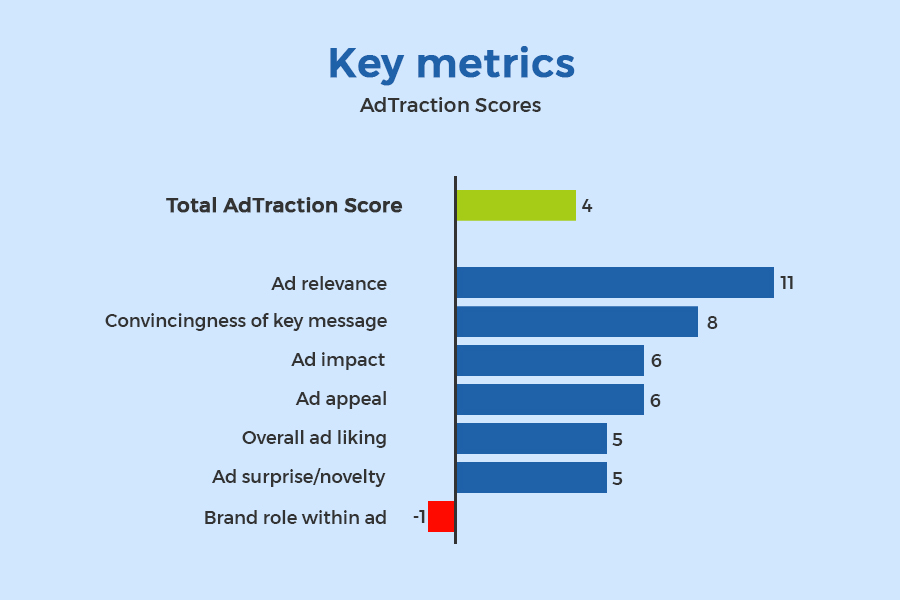
Cimigo has the empirical knowledge to best advise you on what advertising works and what does not for your target group and category. The Cimigo AdTraction advertising test shows how your advertising performs on a set of standard metrics. Your advertising is compared to a benchmark of over 500 advertisements, to find out specific strengths and weaknesses.
Cimigo’s AdTraction advertising test service is available as a self-service RapidSurvey solution or Cimigo can support you with a customised service.
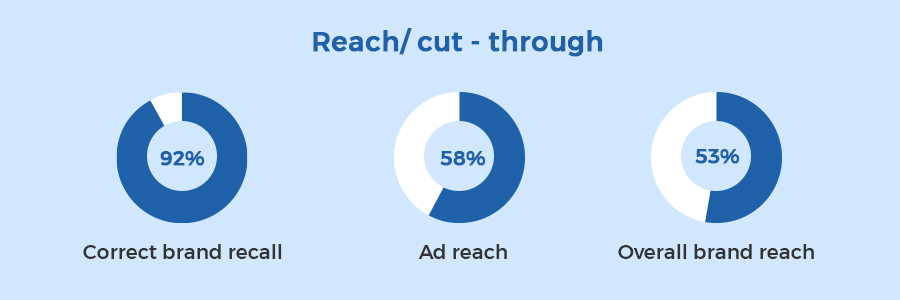
Advertisements are typically tested in an online survey on a rotated basis, one after the other (sequential monadic design). AdTraction metrics include 24 standard attributes, as well as ad recall, brand recognition and three open-ended questions.
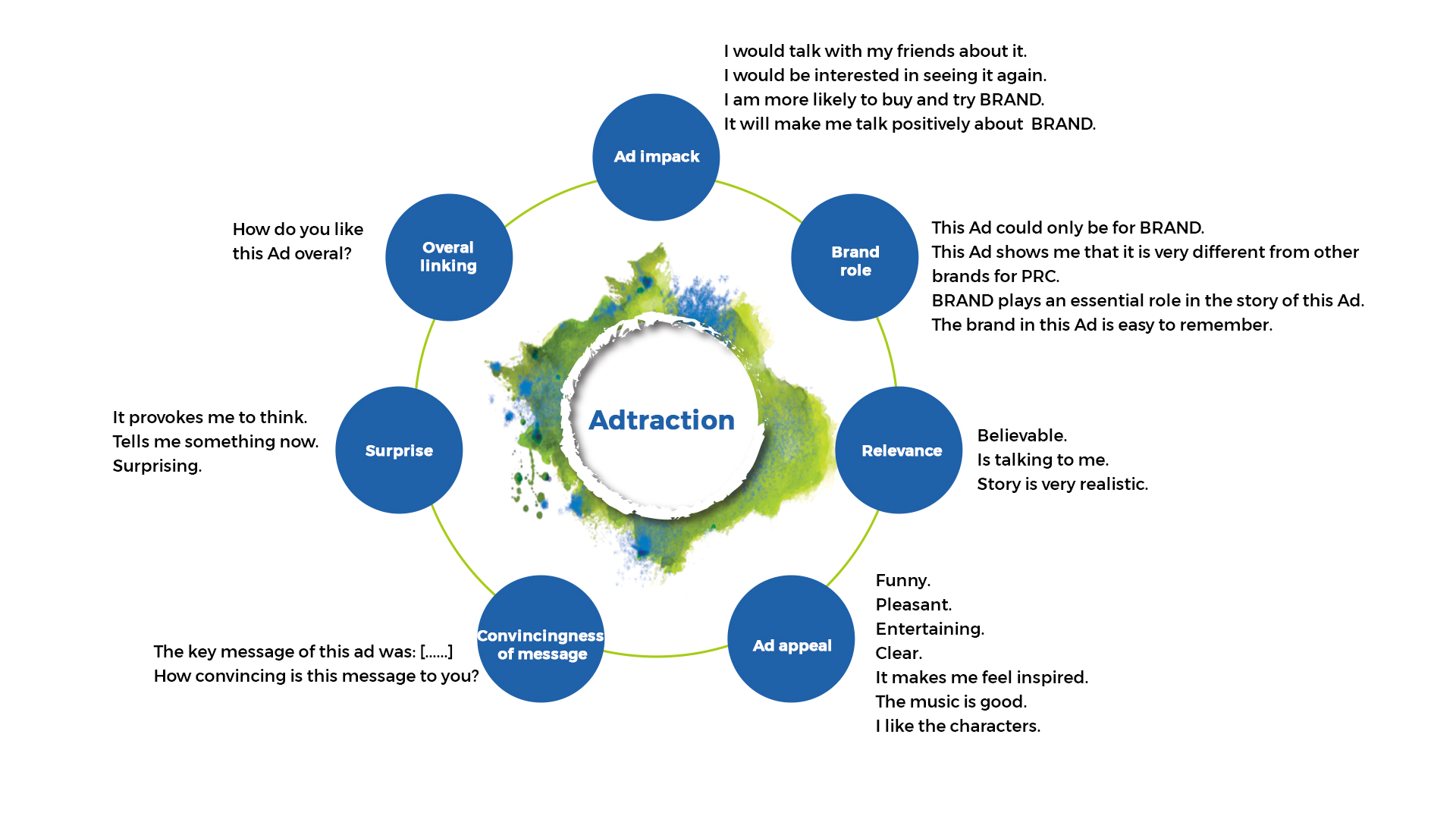
Cimigo’s AdTraction tests the performance of advertising and provides rapid feedback on your advertising performance so you may adjust your communications plan.
- Quickly pre-test.
- Improve emotional engagement.
- Re-visit execution (post editing) and media investments.
- Learn from each advertising to benefit future advertising development.
- Learn from your competitor’s advertising – success or failure.
Learn more about what just makes advertising work here.
Results of the Cimigo AdTraction advertising test will be provided in AdTraction scorecard format.
Scorecard
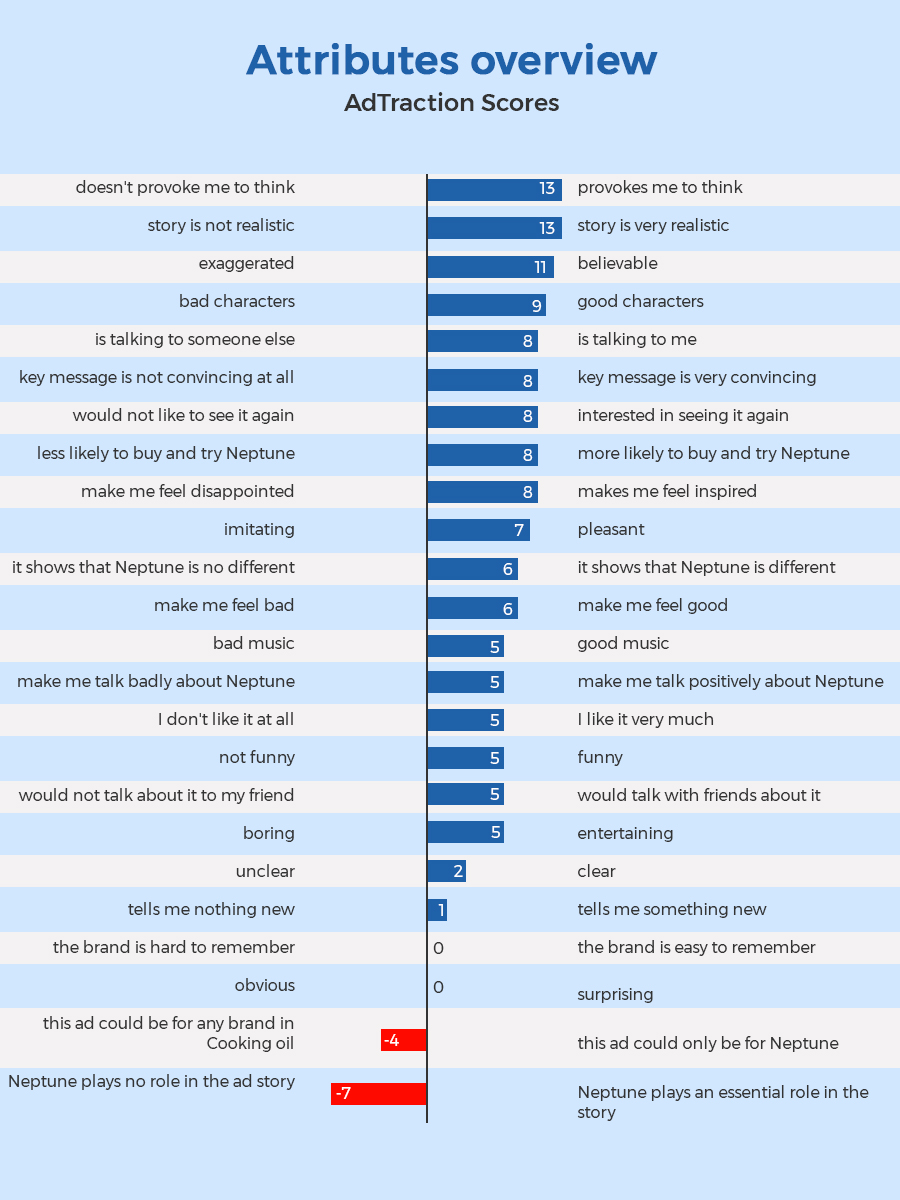
Overall brand performance
Brand reach and cut through
Advertising tests with emotional engagement
AdTraction advertising tests will also tell you what level of emotional engagement and which emotions are being evoked second by second. Cimigo use facial imaging to scientifically measure and analyse emotional response to advertising using the webcam or smartphone camera.
Cimigo’s AdTraction advertising test service is available as a self-service RapidSurvey solution or Cimigo can support you with a customised service.
The result is second by second emotional engagement, translated from the 188 facial muscle movements into emotion. Emotive response determines whether the audience watches an advertisement and determines how well the advertisement can become anchored into the long-term memory of the audience. Seven key emptions can be shown, the example below highlight just two emotions; happiness and sadness.
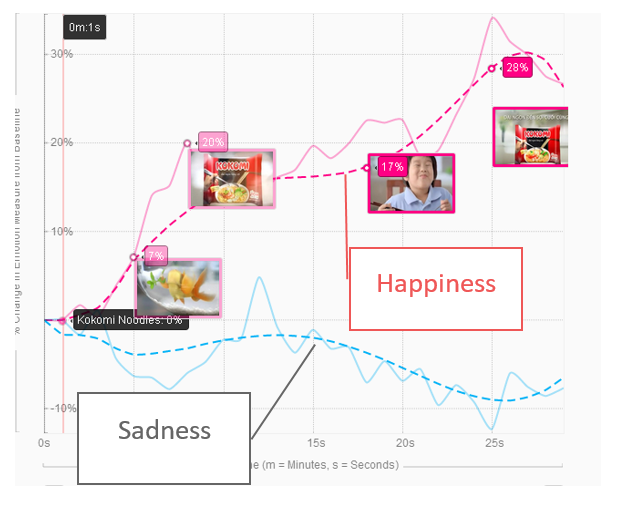
Emotions can be compared and highlighted on a second-by-second basis which supports post editing of any video formats. Emotions are also compared to benchmarks to provide a relative understanding.
The most common impact of emotion response for the creative team is in determining frames within a story line that detract from the story. Specific images may create confusion and generate, fear, anger or disgust (in most cases never the intention of the story teller).
Variation in emotional valence in a story line is perfect (like a good movie which makes up both cry and laugh out loud) but you want to leave the audience feeling good and ensure a negative emotion is followed by positive emotions.
Learn more about what just makes advertising work here.
Further emotional response by second becomes irreplaceable when clients seek to shorten longer spots to shorter posts to increase the audience opportunities to see (viewing frequency).