
Marketing tactics


 Pack development
- Pack tests
- Pack tests with eye tracking
Cimigo’s pack testing research helps organisations compare packaging concepts before launch, identifying which design attracts attention, communicates the intended proposition and is most likely to drive purchase. Packaging is often the most influential marketing asset a consumer encounters. It competes directly with rival brands on the shelf, communicates your brand proposition in seconds, and continues to build brand recognition long after advertising has been forgotten.
Whether you are launching a new product, refreshing an established brand or extending an existing product range, pack testing reduces development risk and provides evidence-based recommendations before significant investment is committed.
What is a pack test?
A pack test is a structured consumer research study that evaluates alternative packaging designs before launch. Rather than relying on internal opinion or design preference, target consumers compare packaging concepts in realistic purchase situations, allowing organisations to understand which design performs best and why. A Cimigo pack test measures:
- Shelf visibility.
- Brand recognition.
- Communication of key messages.
- Purchase intention.
- Product differentiation.
- Premium perception.
- Variant navigation.
- Overall preference.
The result is a packaging design that has been validated with consumers before production begins. Typical pack test study
- Up to 4 packaging concepts.
- Approximately 200 target consumers.
- Interactive online dashboard.
- Results in approximately 10 working days.
- Typical investment: US$2,549 (approximately VND65 million).
- Optional eye tracking.
Why conduct a pack test?
Packaging decisions influence every stage of the customer journey. A successful pack must:
- Capture attention quickly.
- Reinforce distinctive brand assets.
- Communicate the product proposition.
- Differentiate variants.
- Support pricing strategy.
- Build trust.
- Encourage purchase.
Small changes in colour, imagery, typography, structure or information hierarchy can significantly influence consumer behaviour. Testing packaging before launch helps reduce uncertainty and improves confidence in important commercial decisions.
Cimigo insight
Packaging is your most persistent marketing medium. Every unit sold carries your brand into retail environments, consumers’ homes and everyday usage occasions. Unlike advertising campaigns, packaging continues building brand equity throughout the product’s life.The Cimigo packaging performance framework
Successful packaging is more than attractive design. It must perform across multiple dimensions simultaneously. A package may attract attention but fail to communicate its proposition. It may communicate well but create confusion between product variants. It may encourage first purchase but fail to reinforce confidence after use.
At Cimigo, we don’t simply report research metrics. We interpret how packaging performs against five commercial dimensions that influence consumer choice and long-term brand performance.
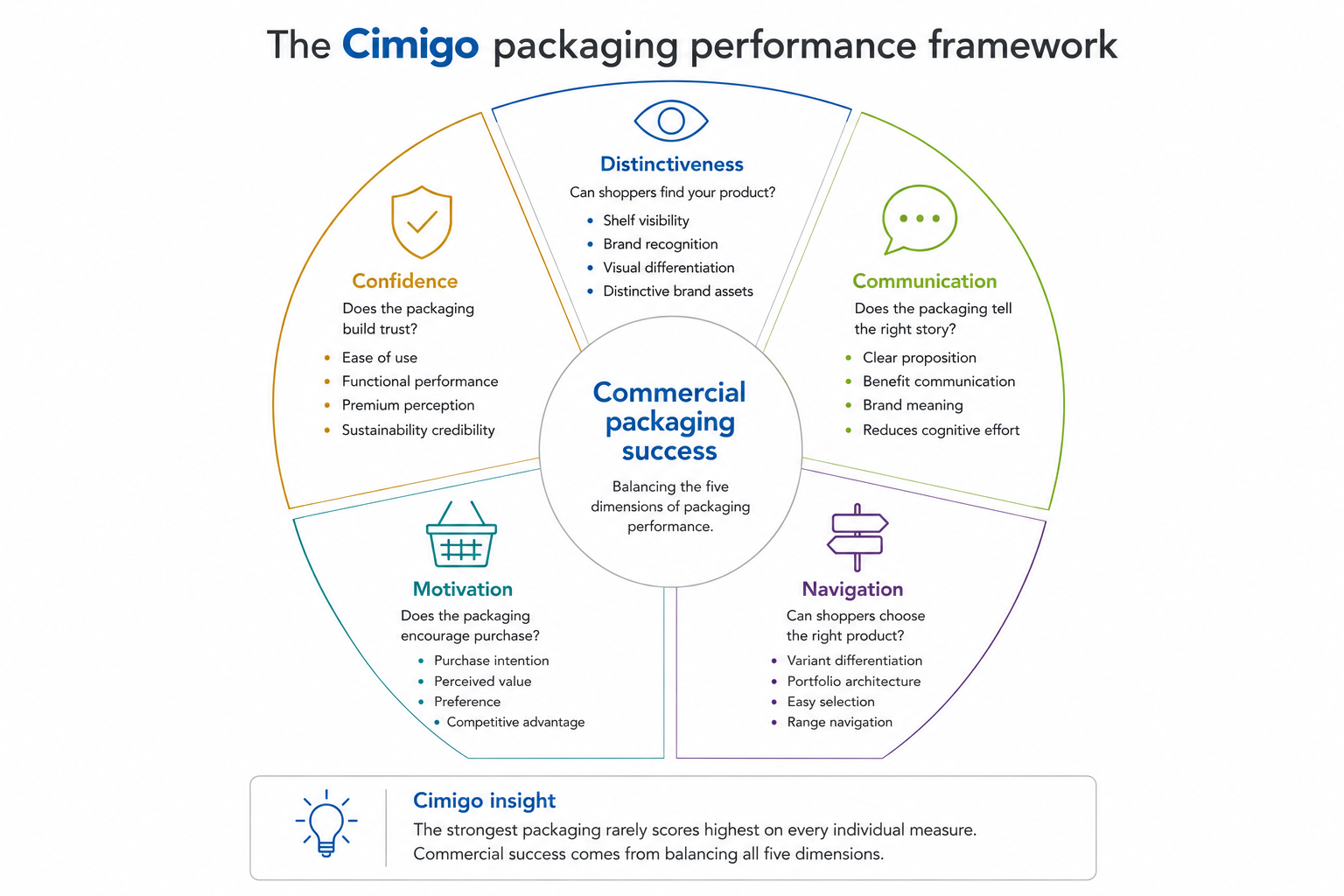
1. Distinctiveness: Can shoppers find your product?
The first challenge is attracting attention within a crowded retail environment. Packaging must stand out against competing brands while reinforcing your distinctive brand assets. We evaluate:
- Shelf visibility.
- Brand recognition.
- Visual differentiation.
- Recall of key brand assets.
A package that cannot be found cannot be chosen.
2. Communication: Does the packaging tell the right story?
Consumers often spend only one or two seconds evaluating packaging. During that brief moment, the pack must communicate what the product is, why it matters and why it deserves consideration. We assess whether consumers correctly interpret the intended positioning, including quality, efficacy, naturalness, premium credentials, convenience and sustainability. Good packaging reduces cognitive effort by communicating clearly and quickly.
3. Navigation: Can shoppers make the right choice?
Modern brands often have extensive portfolios across flavours, formats, sizes and price tiers. Packaging should help shoppers navigate these choices without confusion. We evaluate:
- Variant differentiation.
- Product hierarchy.
- Portfolio architecture.
- Ease of product selection.
Effective navigation reduces purchase errors and improves the shopping experience.
4. Motivation: Does the packaging encourage purchase?
Packaging should do more than communicate. It should motivate action. We assess:
- Purchase intention
- Perceived value
- Overall preference
- Competitive advantage
Just as importantly, we identify why one design motivates purchase more effectively than another.
5. Confidence: Does the packaging reinforce trust after purchase?
The role of packaging continues after the product leaves the shelf. It should reinforce quality, support usability and strengthen confidence in the brand throughout the ownership experience. Depending on the category, we evaluate:
- Ease of opening and dispensing.
- Functional performance.
- Premium perception.
- Sustainability credibility.
- Overall confidence in the product.
Packaging that builds confidence today contributes to repeat purchase tomorrow.
Cimigo insight
Most research companies report pack test scores. Cimigo interprets what those scores mean for commercial performance and translates them into practical packaging recommendations. The strongest packaging rarely scores highest on every individual measure. Success comes from achieving the right balance between Distinctiveness, Communication, Navigation, Motivation and Confidence. Our consultants identify that balance and provide practical recommendations to optimise packaging before production begins.Cimigo pack testing approach
Every study is tailored to the commercial objectives of the client, category and market. 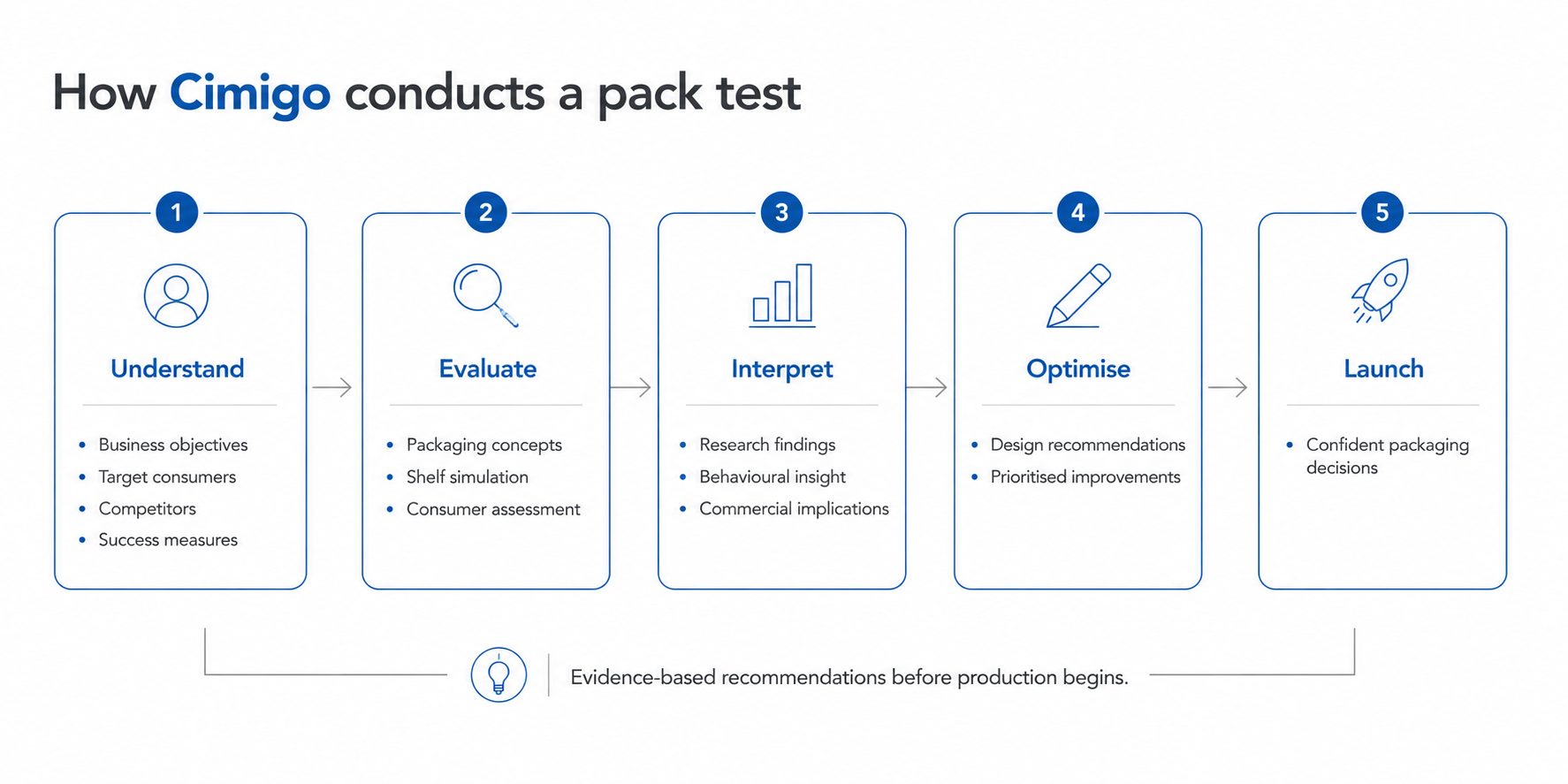
Define the objectives
We begin by understanding:
- Your business challenge.
- Target consumers.
- Competitive landscape.
- Success criteria.
Evaluate packaging concepts
Consumers compare up to four packaging concepts, individually and within competitive shelf environments where appropriate. Benchmarking against competitor packaging provides valuable commercial context.
Simple quantitative pack tests often compare new designs with current designs to determine preference. They are typically tested on a rotated basis, one after the other (sequential monadic design) before being compared side by side.
Cimigo’s pack testing service is available as a self-service RapidSurvey solution. Cimigo can also support you with a customised research service.
Analyse consumer response
Our consultants evaluate each concept across multiple performance measures and identify the reasons behind consumer preferences. Rather than simply reporting scores, we explain what the results mean for your packaging strategy.
Optimise before launch
The research concludes with practical recommendations covering:
- Visual hierarchy.
- Brand assets.
- Message communication.
- Variant architecture.
- Design improvements.
This allows packaging to be refined before artwork is finalised and production begins.
Eye tracking for pack testing
Traditional pack testing tells you what consumers say. Eye tracking shows what they actually see. Using realistic virtual shelf environments, eye tracking measures how shoppers visually interact with packaging before making purchase decisions. Metrics include:
- First fixation.
- Time to first notice.
- Gaze duration.
- Heat maps.
- Areas of visual attention.
- Comparison with competing brands.
Behavioural evidence complements survey responses and helps optimise packaging for maximum shelf impact.
Pack tests with eye tracking
Eye tracking is often deployed in addition to survey questions. This helps Cimigo to determine the impact the pack has on shoppers in store and on the shelf. Occasionally this uses a mock store environment, but this setup is prohibitively expensive for many clients. Eye tracking technology is often a virtual solution that can be conducted with the target group online.
Typically, packs including competitors are shown on virtual shelf so that Cimigo can learn how shoppers scan their shopping environment and just what grabs attention. The ability to gauge exactly what is looked at, for how long and in what order enables Cimigo to help you make better decisions on which pack option to pursue and how best to optimise it.
Cimigo’s pack testing service is available as a self-service RapidSurvey solution. Cimigo can also support you with a customised research service.
Eye tracking enables Cimigo to determine;
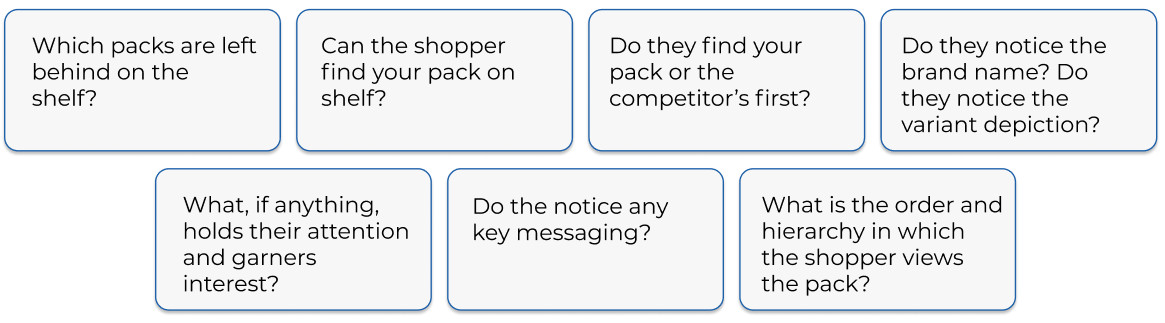
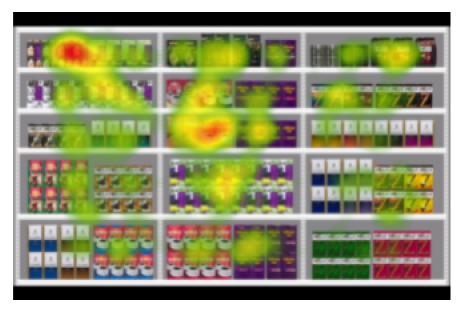
Quantitative metrics allow Cimigo to identify which packaging is attracting first gaze and length of gaze to determine which attract attention and hold attention.
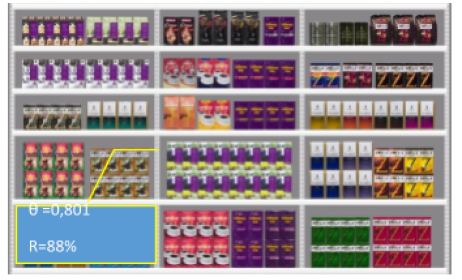
With eye tracking Cimigo can identify what in the range is actually looked at and in what concentration. Using “fixations” (i.e. when a consumer focuses) Cimigo have clear metrics on the speed at which a product is found; the extent to which it is focused on; and whether respondents come back to look at the product again. All of these metrics mean Cimigo can identify the effectiveness of a product standing out and therefore its ability to capture the attention of consumers.
In this Clear Asahi beer example, the gaze movement from mid-to-upper; indicates viewing of the brand logo and beer bubbles logo motif in the centre which includes a brand message. Fixations demonstrate that most time is spent on the brewer’s name ahead of the brand variant.
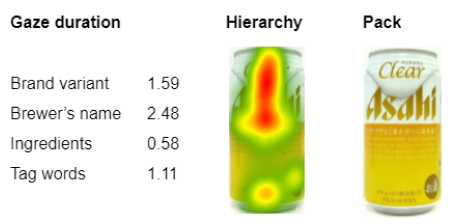
At the individual pack-level, Cimigo can also determine key messaging, hierarchy and fixations. Hence Cimigo can determine in what order and for how long respondents spend on key elements of the packaging. This enables Cimigo to determine whether respondents are spending time (and seeing) key communication elements or whether they are confused or spending time on elements that are not helpful in increasing understanding of the brand and its features.
Comparing across pack designs enables Cimigo to help you make better choices and to ensure your pack does not get left behind on the shelf.
Cimigo insight
Consumers rarely analyse packaging element by element. They respond to the overall impression created by colour, typography, imagery, structure and materials working together. Effective pack testing identifies the combination that communicates your intended brand meaning most successfully.Pack testing applications
Pack testing supports organisations throughout the innovation process. Typical applications include:
New product launches
Select the strongest packaging before launch.
Packaging redesign
Modernise packaging while protecting existing brand recognition.
Product line extensions
Help consumers distinguish between flavours, sizes and product variants.
Premiumisation
Evaluate whether packaging supports higher pricing and stronger quality perceptions.
Sustainability initiatives
Test new materials and environmental messaging before implementation.
Seasonal and limited editions
Develop culturally relevant packaging while maintaining long-term brand recognition.
Common reasons packaging redesigns fail
A successful packaging redesign should strengthen brand recognition while improving shopper engagement. However, even well-intentioned redesigns can reduce visibility, confuse consumers or weaken purchase intent if they are not tested before launch.
Changing distinctive brand assets too aggressively
Consumers rely on familiar visual cues to recognise brands quickly on the shelf. Significant changes to logos, colours, typography or pack structure can reduce recognition and make established brands harder to find. Effective redesigns evolve distinctive brand assets rather than replacing them.
Overloading the front of pack
Packaging often has only a few seconds to capture attention. Adding too many claims, messages or design elements can create visual clutter and make it difficult for shoppers to identify the brand, product or key benefit. Clear visual hierarchy is usually more effective than communicating everything at once.
Weak variant differentiation
As product portfolios grow, consumers need to distinguish between flavours, sizes, formulations or benefits quickly. Poor variant architecture can lead to confusion, incorrect product selection or lost sales. Pack testing helps identify whether shoppers can easily navigate the range.
Following design trends instead of shopper behaviour
Contemporary design trends may appeal to internal stakeholders but do not always improve commercial performance. The most successful packaging is based on how consumers notice, interpret and choose products in real shopping environments, rather than aesthetic preferences alone.
Testing too late in the development process
Packaging changes become increasingly expensive once artwork is finalised or production has begun. Testing concepts early allows organisations to refine designs while changes are still practical and cost-effective, reducing the risk of costly redesigns after launch.
Cimigo insight
Many unsuccessful packaging redesigns are not caused by poor design, but by assumptions about how shoppers behave. Pack testing provides objective evidence to help organisations optimise packaging before committing to production.Why choose Cimigo?
Since 2003, Cimigo has helped leading organisations across Vietnam and Indonesia make better innovation decisions through evidence-based consumer research. Our consultants combine quantitative research, qualitative insight and behavioural methodologies with deep understanding of Southeast Asian consumers and retail environments. Clients value Cimigo because we provide:
- Local expertise across Vietnam and Indonesia.
- Independent, evidence-based recommendations.
- Practical commercial advice.
- Interactive dashboards.
- Rapid turnaround.
- Experienced innovation researchers.
Our objective is not simply to identify the preferred packaging design, but to explain why it performs better and how it can be improved further.
Pack testing deliverables
Every pack testing project provides practical outputs designed to support confident decision-making. Deliverables typically include:
- Executive summary.
- Packaging performance scorecards.
- Ranking of concepts.
- Purchase intention analysis.
- Brand communication assessment.
- Consumer verbatim comments.
- Design recommendations.
- Interactive dashboard.
Optional eye tracking provides additional behavioural analysis through visual attention heat maps and gaze metrics.
Pack testing timing and investment
Our standard pack testing solution includes:
- Up to 4 packaging concepts.
- Approximately 200 target consumers.
- Interactive online dashboard.
- Results in approximately 10 working days.
- Typical investment: US$2,549 (approximately VND65 million).
- Optional eye tracking. Additional US$1,080 (approximately VND27.5 million).
Please contact us for customised methodologies, larger sample sizes or multi-country studies.
Frequently asked questions
What is a pack test?
A pack test compares alternative packaging designs with target consumers to identify which concept performs best before launch.
When should packaging be tested?
Ideally before artwork is finalised and before production tooling begins, when changes remain relatively inexpensive.
Should I test packaging before product testing?
It depends on the stage of development and the decision you need to make. If both the product and packaging are still evolving, we generally recommend testing the product first to ensure it meets consumer expectations. Once the product concept is validated, pack testing helps identify the packaging design that best communicates the product’s benefits and encourages purchase.
For products where packaging plays a major role in consumer choice, such as FMCG, beverages, personal care and healthcare, pack testing is often conducted alongside or immediately after product testing as part of an integrated innovation programme.
How many pack concepts should be included?
Most pack testing studies compare between two and four packaging concepts. Testing too few concepts may limit learning, while testing too many can increase respondent fatigue and reduce the quality of feedback.
We generally recommend evaluating up to four concepts, together with relevant competitor packaging where appropriate. The optimal number depends on your objectives, the maturity of the designs and the decisions the research is intended to support.
Can unfinished packaging concepts be evaluated?
Yes. Digital artwork, mock-ups and early packaging concepts can all be tested during development.
Should competitors be included?
Yes. Competitive benchmarking helps identify opportunities for stronger differentiation and better shelf performance.
Can Cimigo conduct pack tests across multiple countries?
Yes. We regularly conduct comparable pack testing studies across Vietnam, Indonesia and other Southeast Asian markets using consistent methodologies while reflecting local shopping behaviour.
Can eye tracking be added?
Yes. Eye tracking provides objective behavioural evidence showing exactly how shoppers visually engage with packaging in realistic retail environments.
What makes a successful pack test?
A successful pack test goes beyond identifying the preferred design. It explains why one concept performs better and provides clear recommendations for improvement. At Cimigo, we interpret packaging using the Cimigo packaging performance framework, evaluating five dimensions of commercial performance: Distinctiveness, Communication, Navigation, Motivation and Confidence. This helps organisations make informed design decisions rather than simply choosing the highest-scoring concept.
Related innovation solutions
Pack testing is one part of successful product innovation. Related Cimigo solutions include:
- Pack development.
- Pack testing with eye tracking.
- New product development research.
- Concept development and testing.
- Product testing.
- Pricing research.
- Shopper research.
- Route to market research.
Together these solutions support organisations from early innovation through to successful commercial launch.
Talk to a packaging research specialist
Choosing the right packaging is one of the most important decisions in product development. Cimigo’s pack testing solution helps organisations identify the packaging design most likely to succeed before production begins, reducing commercial risk and improving in-market performance. Contact one of our consultants to discuss the most appropriate pack testing approach for your category, market and business objectives.