Indonesia consumer trends 2026
Oct 18, 2026
Indonesia consumer trends 2026 Indonesia‘s economy continues to demonstrate resilience in

Willingness to pay for AI in Indonesia
 Admin
Admin
 Aug 06, 2026
Willingness to pay for AI in Indonesia remains low. Consumer AI in Indonesia is everywhere, but paid AI users are not. Persuading them to pay for it is proving to be an entirely different challenge. This article is based on a study on willingness to pay in Indonesia conducted by Cimigo in 2026, with 244 respondents.
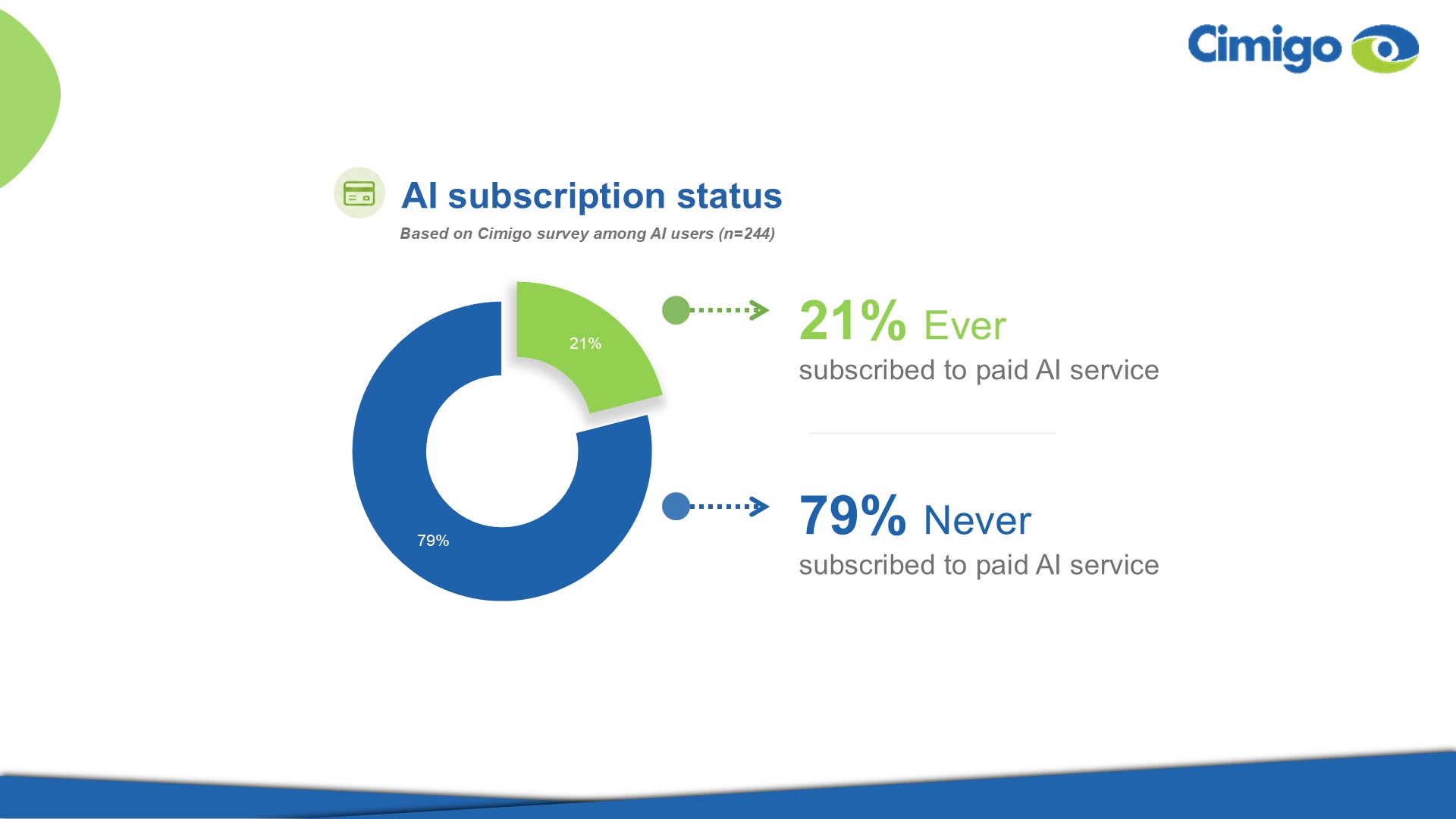
AI subscription status among Indonesian AI users
Productivity AI is by far the most widely used category among Indonesian consumers, used by 71% of AI users, with translation AI in second place at 52%. This pattern shifts once money changes hands. Productivity AI remains the leading paid category at 16% of AI users, but creative AI overtakes translation AI among paying users. Productivity AI continues to dominate, whether consumers are paying or not.
The reasons people give for subscribing reinforce this pattern. Among paid AI subscribers, 76% cite unlimited use, 48% cite working more efficiently and 45% cite access to more advanced models. Willingness to pay for AI in Indonesia, in other words, is driven by what the tool does for them, not by the novelty of the technology itself.
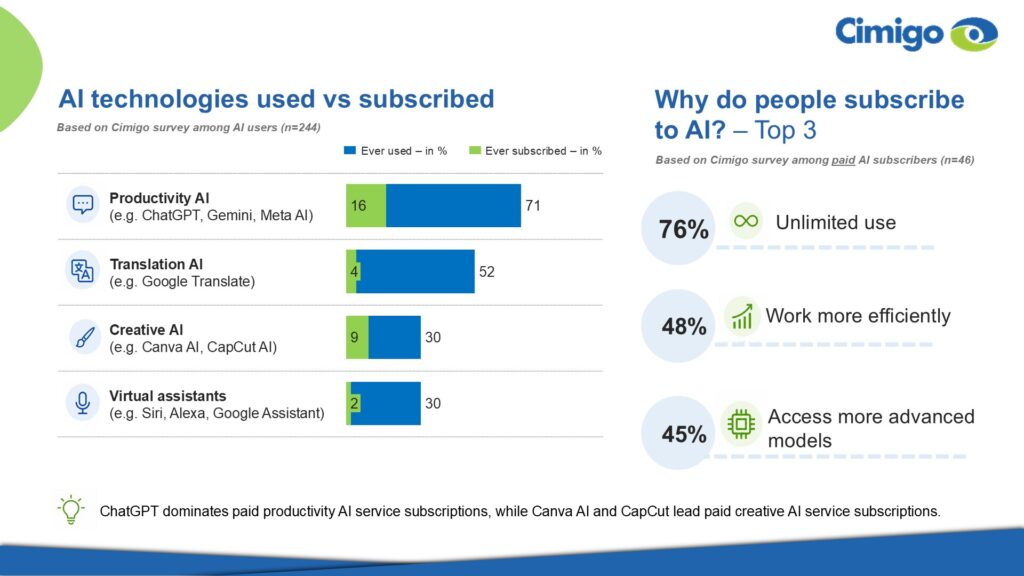
AI technologies used versus subscribed, and top reasons for subscribing
Cimigo’s research looked closely at consumers who have never subscribed to a paid AI service, and one finding stood out immediately. The barriers these consumers cite and the triggers that would persuade them to subscribe almost mirror each other.
Among non-paid AI users, the top barriers are that the free version is already enough (47%), infrequent AI use (37%), cost concerns or uncertainty about value (30%), still trialling the free version before deciding (25%), and data privacy or security concerns (11%). The top triggers that would change their mind are strikingly similar in shape: access to advanced features they genuinely need (49%), relying on AI more for work or study (44%), more affordable pricing (30%), time savings and efficiency (29%), and better data security and privacy protection (26%).
The common thread is clear: Indonesian consumers need a stronger reason to see the value in premium AI.
For AI providers, this reframes the challenge. Getting people to try AI is no longer the difficult part. Helping them understand why upgrading is worthwhile is. Three priorities stand out from the data:
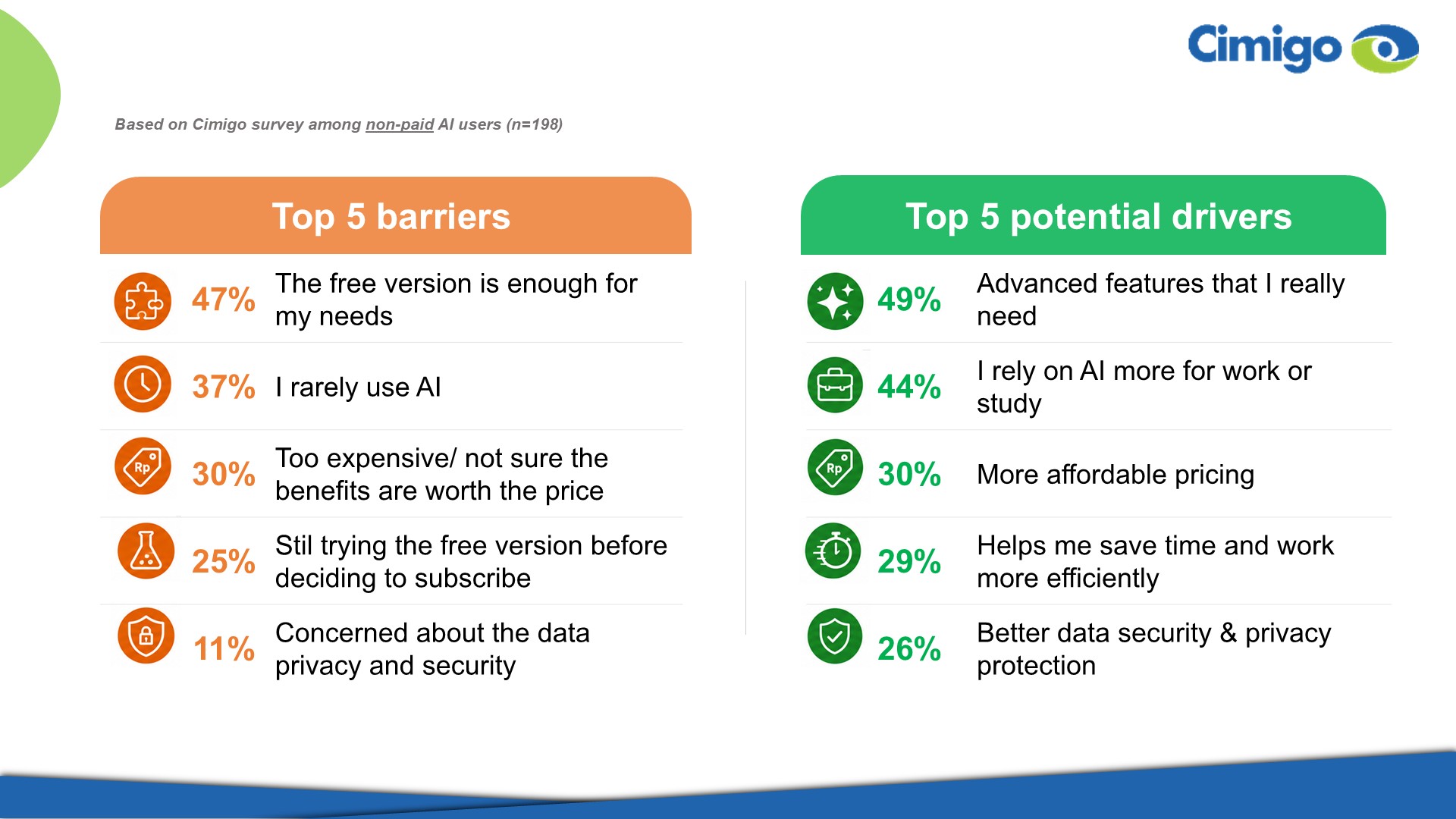
Top five barriers and top five potential drivers to paid AI subscription among non-paid users
Cimigo’s findings suggest that free AI is not the problem holding back paid conversion. If anything, free access remains an essential part of how Indonesian consumers discover AI tools and build habits around them, with a quarter of non-subscribers (25%) still actively trialling the free version before deciding whether to upgrade.
The real challenge for providers is not simply deciding which features belong behind a paywall. It is finding the right balance: too much left free reduces the incentive to upgrade, whilst premium that feels too limited risks users walking away altogether. How premium is communicated may matter just as much as what it actually offers.
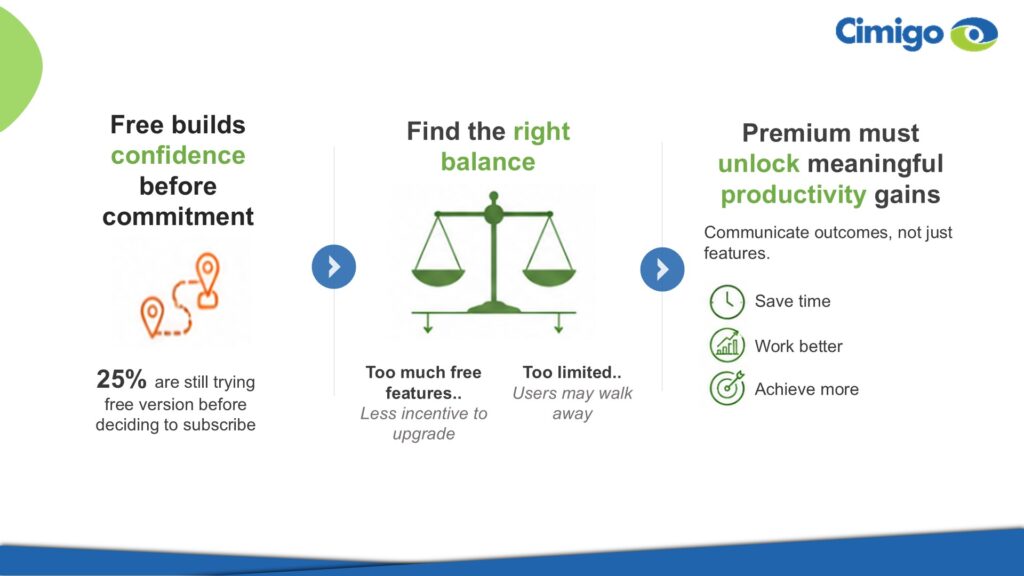
The path from free to premium: building confidence, finding the right balance, and unlocking meaningful productivity gains
Indonesian consumers rarely describe premium AI in terms of features. Instead, they talk about outcomes: saving time, working more efficiently and achieving better results. Premium AI offerings become more compelling when they are communicated through the value they create, rather than the specifications they include.
What creates that value will not be identical for every product or every audience. Understanding precisely where users begin to see premium as worthwhile is exactly the kind of question customer research is designed to answer.
Willingness to pay for AI in Indonesia is not fixed. It is a moving line that shifts as consumers come to understand what premium genuinely offers them. For AI providers and marketers building strategy around the Indonesian market, three actions follow directly from these findings:
If you have any questions or specific needs, please get in touch with us at ask@cimigo.com.

Indonesia consumer trends 2026
Oct 18, 2026
Indonesia consumer trends 2026 Indonesia‘s economy continues to demonstrate resilience in

Vietnam’s consumer outlook 2027
Oct 14, 2026
Vietnam’s consumer outlook 2027: Why strong economic growth does not guarantee consumer
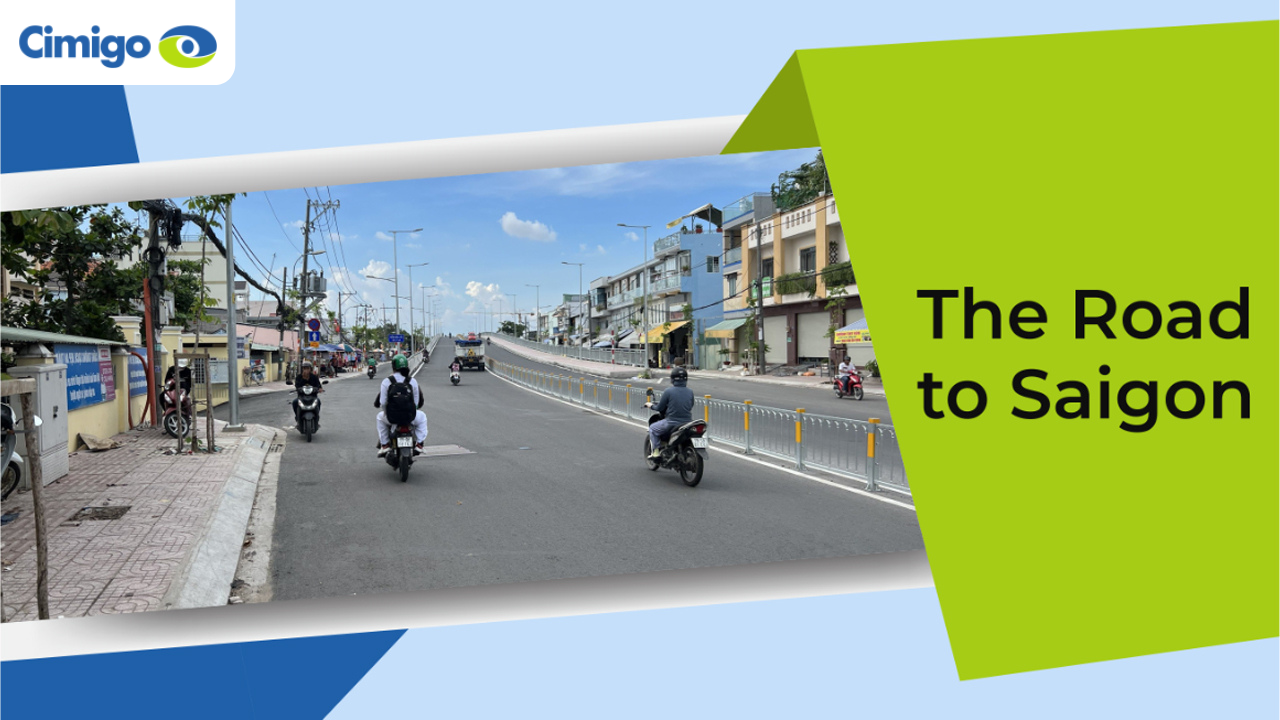
The Road to Saigon
Apr 15, 2025
Watch the Road to Saigon and learn about the stories of the residents. Understand their lives,

Đoàn Ngọc Huy (Johnny Doan), CMO & Market Research Expert -
As a Marketing Director and Market Research Expert Advisor across international markets, I have collaborated with numerous market research agencies, both global and local, that operate with a high level of professionalism and effectiveness. Cimigo is among the most outstanding. The Cimigo team demonstrates exceptional professionalism, strong commitment, and operational excellence. From research design and fieldwork execution to insight analysis, all stages are conducted rigorously, delivered on schedule, and closely aligned with business objectives. This is a highly capable team that I would confidently recommend to my partners and stakeholders.
As a Marketing Director and Market Research Expert Advisor across international markets, I have collaborated with numerous market research agencies, both global and local, that operate with a high level of professionalism and effectiveness. Cimigo is among the most outstanding. The Cimigo team demonstrates exceptional professionalism, strong commitment, and operational excellence. From research design and fieldwork execution to insight analysis, all stages are conducted rigorously, delivered on schedule, and closely aligned with business objectives. This is a highly capable team that I would confidently recommend to my partners and stakeholders.
Lisa Nguyen - Vietnam Marketing Lead

Mark Ratcliff - Managing Director
The team at Cimigo are my favourite researchers in South East Asia. They’ve proved adept at tackling the most private and complex personal issues at qualitative research level, not flinching when the client endlessly chopped and changed fieldwork timing, or ramped up the workload without warning. They have recruited the most extraordinarily niche consumers without pause or complaint. Their patience with clients and their flexibility and hard work that went above and beyond what was initially asked of them on two projects relating to sexual behaviour means there is now no other research company we would choose to work with in that part of Asia. The fact they also pulled off a third project for us so well, on men’s relationship with beer and beer advertising, shows they have breadth of expertise— we still quote from the report they produced.
The team at Cimigo are my favourite researchers in South East Asia. They’ve proved adept at tackling the most private and complex personal issues at qualitative research level, not flinching when the client endlessly chopped and changed fieldwork timing, or ramped up the workload without warning. They have recruited the most extraordinarily niche consumers without pause or complaint. Their patience with clients and their flexibility and hard work that went above and beyond what was initially asked of them on two projects relating to sexual behaviour means there is now no other research company we would choose to work with in that part of Asia. The fact they also pulled off a third project for us so well, on men’s relationship with beer and beer advertising, shows they have breadth of expertise— we still quote from the report they produced.

Kevin McQuillan - Chief Marketing Officer
Sam Houston - Chief Executive Officer

Minh Thu - Consumer Market Insights Manager
Travis Mitchell - Executive Director
Malcolm Farmer - Managing Director
Hy Vu - Head of Research Department
Joe Nelson - New Zealand Consulate General
Steve Kretschmer - Executive Director
York Spencer - Global Marketing Director

Laura Baines - Programmes Snr Manager
Mai Trang - Brand Manager of Romano

Hanh Dang - Product Marketing Manager
Luan Nguyen - Market Research Team Leader
Max Lee - Project Manager

Chris Elkin - Founder
Ronald Reagan - Deputy Group Head After Sales & CS Operation
Chad Ovel - Partner

Private English Language Schools - Chief Executive Officer
Rick Reid - Creative Director

Anya Nipper - Project Coordination Director

Dr. Jean-Marcel Guillon - Chief Executive Officer
Joyce - Pricing Manager

Matt Thwaites - Commercial Director

Aashish Kapoor - Head of Marketing

Kelly Vo - Founder & Host
Thanyachat Auttanukune - Board of Management
Hamish Glendinning - Business Lead

Thuy Le - Consumer Insight Manager
Richard Willis - Director

Ha Dinh - Project Lead
Geert Heestermans - Marketing Director

Vo Thi Thuy Ha - Commercial Effectiveness

Louise Knox - Consumer Technical Insights
Aimee Shear - Senior Research Executive
Dennis Kurnia - Head of Consumer Insights
Tania Desela - Senior Product Manager
Thu Phung - CTI Manager
Linda Yeoh - CMI Manager

 Team
Team
Cimigo’s market research team in Vietnam and Indonesia love to help you make better choices.
 Solutions
Cimigo provides market research solutions in Vietnam and Indonesia that will help you make better choices.
 Trends
Cimigo provides a range of consumer marketing trends and market research on market sectors and consumer segments in Vietnam and Indonesia.
 Reports
Cimigo provides a range of free market research reports on market sectors and consumer segments in Vietnam and Indonesia.