Vietnam’s consumer outlook 2027
Oct 14, 2026
Vietnam’s consumer outlook 2027: Why strong economic growth does not guarantee consumer

Vietnam’s consumer outlook 2027
 Richard Burrage
 Oct 14, 2026
Vietnam’s consumer outlook 2027 examines the widening difference between national economic performance and the financial realities facing Vietnamese households, retailers and consumer businesses.
Vietnam’s economy is expanding rapidly, but strong GDP growth does not automatically mean strong consumer spending or business revenue growth.
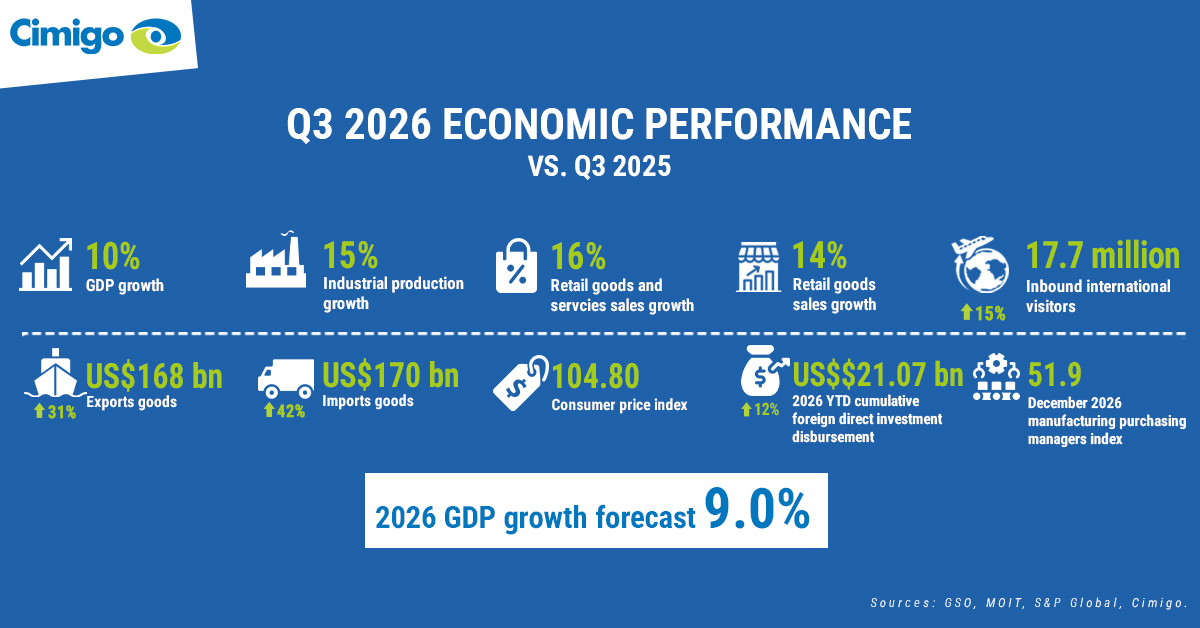
Vietnam’s real GDP grew by 9.95% year on year in Q3 2026. Manufacturing, construction, investment and exports continue to generate considerable economic momentum. Yet consumer confidence remains below 2025 levels, household budgets face increasing pressure, and spending is shifting between categories, services and retail channels.
Economic growth measures the expansion of production and expenditure across the economy. Consumer businesses depend on something more specific: the number of people buying their products, how often they buy, how much they are prepared to spend, and which brands and channels they choose.
Vietnam’s growth story is changing. The period when expanding employment, urbanisation and household incomes could support broad-based consumer growth is giving way to a more selective market.
For business leaders planning 2027, the critical question is not simply how quickly Vietnam will grow. It is where that growth will occur, which households will benefit and how changing consumer behaviour will translate into category demand.
Vietnam remains an attractive growth market, but the sources and distribution of growth are changing. Investment and manufacturing are expanding considerably faster than employment, households are managing financial commitments more carefully, and consumer expenditure is shifting towards different products, services and shopping channels.
Three developments are particularly important for 2027.
These forces create a more demanding environment for business planning. Companies can no longer assume that national GDP growth, rising average incomes or expanding retail sales will translate proportionately into their own revenue.
As explored in Cimigo’s analysis of how Vietnam’s growth story is changing, Vietnam is moving beyond the earlier phase of economic catch-up, when favourable demographics, expanding employment and increasing market penetration provided powerful growth opportunities. Future success will depend more heavily on productivity, consumer confidence, competitiveness and execution.
Vietnam’s real GDP increased by 9.95% year on year in Q3 2026, according to the National Statistics Office (NSO).
However, just over 60% of this growth is attributable to five sectors. Manufacturing was the largest individual contributor, adding 3.19 percentage points to economic growth. Wholesale and retail trade contributed 0.99 percentage points, construction 0.85 percentage points, transport and warehousing 0.58 percentage points, and financial services 0.52 percentage points.
This composition matters. Manufacturing and infrastructure growth generate employment, business activity and household income, but their benefits extend through the wider economy at different speeds.
Foreign-invested enterprises accounted for 81% of Vietnam’s goods exports during the first nine months of 2026. Vietnam’s expanding participation in global supply chains is economically important, but export values should not be confused with the income or value added retained by domestic businesses and households.
The difference between industrial output and employment is particularly revealing. Industrial production increased by 12.3% during the first nine months of 2026, while industrial employment was only 3.4% higher year on year in September.
Higher output without comparable employment growth can reflect productivity improvements, mechanisation, greater capacity utilisation and changes in industrial composition. These developments can strengthen the economy while producing a less direct increase in household purchasing power.
During the first nine months of 2026, real gross capital formation increased by 17.88%, compared with 8.51% growth in real final consumption expenditure.
Gross capital formation includes investment in productive assets such as factories, equipment and infrastructure. Final consumption expenditure includes household and government consumption. Both measures are adjusted for inflation.
The difference is substantial. Vietnam is expanding its productive capacity much faster than its current consumption is growing.
This investment can support future economic growth through better infrastructure, increased industrial capacity and improved productivity. However, the benefits may take time to reach consumers and will not necessarily be distributed evenly among industries, occupations or geographic areas.
GDP growth driven by capital investment should not be interpreted as an equivalent increase in consumer demand. For consumer businesses, the distinction between the economy’s productive performance and household spending capacity is essential.
Vietnam increasingly has two different economic experiences operating simultaneously.
The faster-growing economy includes export manufacturing, infrastructure, construction, logistics, industrial services and selected technology and financial activities. These sectors benefit directly from industrial investment, trade and infrastructure development.
The more pressured economy includes parts of domestic discretionary consumption, independent retailing, smaller traders and businesses whose revenues depend predominantly on household purchasing decisions.
This does not mean all domestic consumer sectors are weak, or that industrial growth provides no benefit to households. It means that economic momentum reaches different markets through different mechanisms.
For example, a business supplying industrial equipment may benefit immediately from factory investment. A household appliance retailer may still face customers who postpone purchases due to mortgage repayments and uncertainty about future income.
Both businesses operate in the same growing economy, but their demand conditions can be markedly different.
This divergence was already visible in the Vietnam mid-year economic outlook 2026, which examined strong manufacturing and investment performance alongside weakening business and consumer confidence. The widening gap reinforces the importance of evaluating individual consumer markets rather than relying exclusively on national economic indicators.
Consumer confidence depends on more than current economic output. Households make spending decisions based on their personal financial circumstances, employment expectations, future income security, savings and financial obligations.
Cimigo’s Consumer Profiles research shows a pronounced difference between Vietnam’s economic acceleration and consumer sentiment.
Positive consumer sentiment remained around 62% to 64% throughout 2025. It declined to 53% in Q1 2026, then fell to 41% in Q2 before recovering to 54% in Q3.
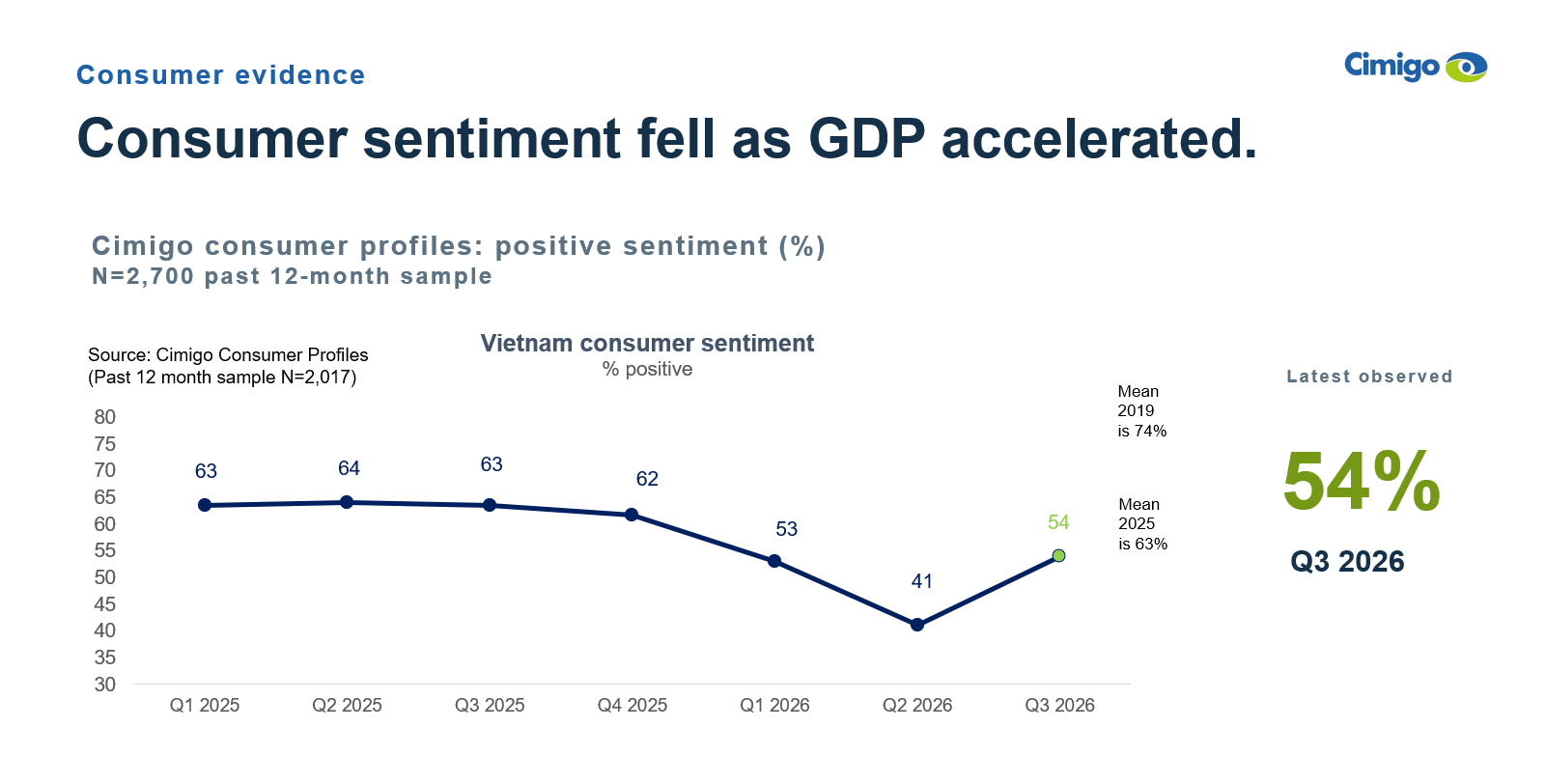
The third-quarter recovery is encouraging. Consumer sentiment improved by approximately 13 percentage points compared with Q2. However, it remains around nine percentage points below the average recorded in 2025.
Importantly, the improvement should not be confused with a complete recovery in purchasing confidence. Consumers can become more optimistic about the economy without immediately increasing discretionary expenditure.
A household may feel more positive about employment conditions while continuing to postpone replacing a refrigerator, purchasing a motorbike or upgrading to a premium product.
The distinction between sentiment and spending behaviour is critical. Confidence influences consumers’ willingness to make financial commitments, but actual expenditure also depends on affordability, competing priorities and perceived value.
Cimigo’s Vietnam consumer trends 2026 identifies a shift towards more deliberate, value-conscious purchasing. Consumers continue to aspire to better products and experiences, but increasingly scrutinise whether the benefits justify the cost. This makes consumer confidence and perceived value important considerations for brands seeking to sustain growth.
Energy costs provide a particularly visible example of the pressures influencing consumer expenditure.
The selected published prices analysed in Cimigo’s October 2026 presentation indicate substantial increases in petrol, diesel and household cooking gas compared with October 2025.
| Energy product | October 2025 to October 2026 price change |
|---|---|
| RON95 petrol | +39.8% |
| Diesel | +53.0% |
| Household LPG, 12 kg cylinder | +57.3% |
Source: Selected published fuel and gas prices compiled for Cimigo’s October 2026 consumer outlook presentation. These are point-in-time comparisons, not annual average price increases.
For households, higher energy prices affect transportation, cooking and other everyday expenses. For businesses, fuel and energy costs can increase distribution, logistics and operating expenditure, potentially placing further pressure on retail prices.
Vietnam’s consumer price index increased approximately 4.8% in Q3 2026 compared with Q3 2025, according to the National Statistics Office. This was higher at 5.08% year on year in September 2026. However, the national CPI is an average measure. The cost pressures experienced by individual households depend on what they purchase, their locations, household composition and financial commitments.
Higher essential expenditure does not eliminate discretionary demand, but it raises the threshold for purchases that are not immediately necessary.
Borrowing costs are another important consideration, particularly for households with mortgages, consumer loans or instalment commitments.
Mortgage introductory rates commonly advertised around 5.5% to 6.5% in 2025 had increased considerably during 2026, with offers around 10% to 11% and some floating rates reaching approximately 15%.
The effect on household expenditure can be significant. Higher monthly debt repayments reduce the amount of income available for other purchases. They can also influence decisions among households not currently borrowing, particularly when consumers are concerned about future financing costs.
Consumer finance supports spending on appliances, electronics, motorbikes, home improvements and other purchases, but higher financing costs can make these commitments less attractive.
For businesses, this creates a distinction between a consumer’s desire to purchase and their willingness or ability to commit financially.
Consumer spending is influenced by expectations about the future, not simply by income received today.
Households consider whether their earnings are secure, what financial reserves they need and how much flexibility they should preserve for unexpected expenses.
Cimigo’s earlier analysis of Vietnam’s ambition to achieve high-income status by 2045 highlights the importance of confidence in converting rising affluence into stronger domestic demand.
For brands, this helps explain why households may maintain expenditure on trusted essentials while delaying discretionary upgrades or searching more actively for value.
Rising incomes create the capacity to spend. Financial confidence influences the willingness to spend. Effective consumer demand depends on both.
Vietnam’s demographic development is beginning to alter the composition of consumer expenditure.
Cimigo’s demographic analysis indicates that people aged over 50 represented approximately 18% of Vietnam’s population in 2010, rising to around 28% in 2026. Over the same period, the crude birth rate declined from approximately 17.1 to 13.7 births per thousand people.
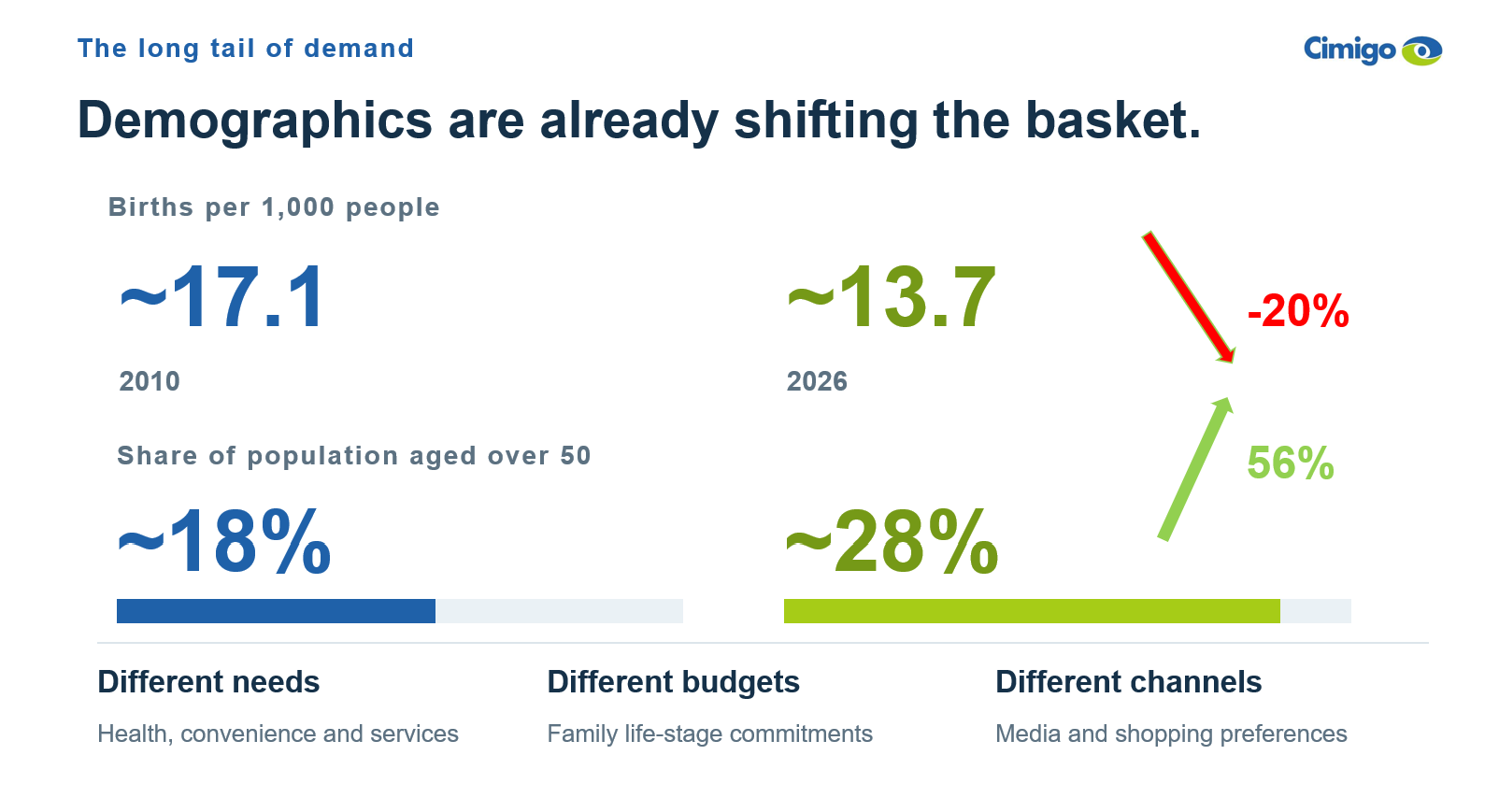
These changes are commercially important because the composition of household demand changes as consumers move through different life stages.
An ageing population can create opportunities in healthcare, nutrition, financial protection, personal wellbeing, convenience, and products that support independent living. At the same time, lower birth rates and smaller families may reshape demand for baby care, children’s products, education, family housing and related categories.
Growth will depend on the purchasing power, needs, preferences and accessibility of the relevant consumers.
For example, declining birth rates may reduce the number of potential buyers in some child-related categories. At the same time, rising expenditure per child could support premium products or services within particular household segments.
The important implication is that changes in the number and composition of consumers can matter as much as changes in average income.
Vietnam’s demographic transition is also central to its longer-term economic ambitions. As discussed in Cimigo’s high-income status analysis, population ageing makes productivity improvements increasingly important. For consumer businesses, the same transition requires more precise segmentation by life stage, household needs and purchasing behaviour.
Vietnam’s retail transformation involves more than consumers moving from physical shops to online marketplaces. Digital platforms are changing how products are discovered, evaluated, compared and purchased.
Cimigo’s Vietnam Media Habits research shows that social media, short-form video, online shopping, shoppable video and television form overlapping parts of consumers’ daily media activities.
Two periods are particularly important: late morning and lunchtime, between 11:00 and 13:00, and the evening, between 19:00 and 22:00.
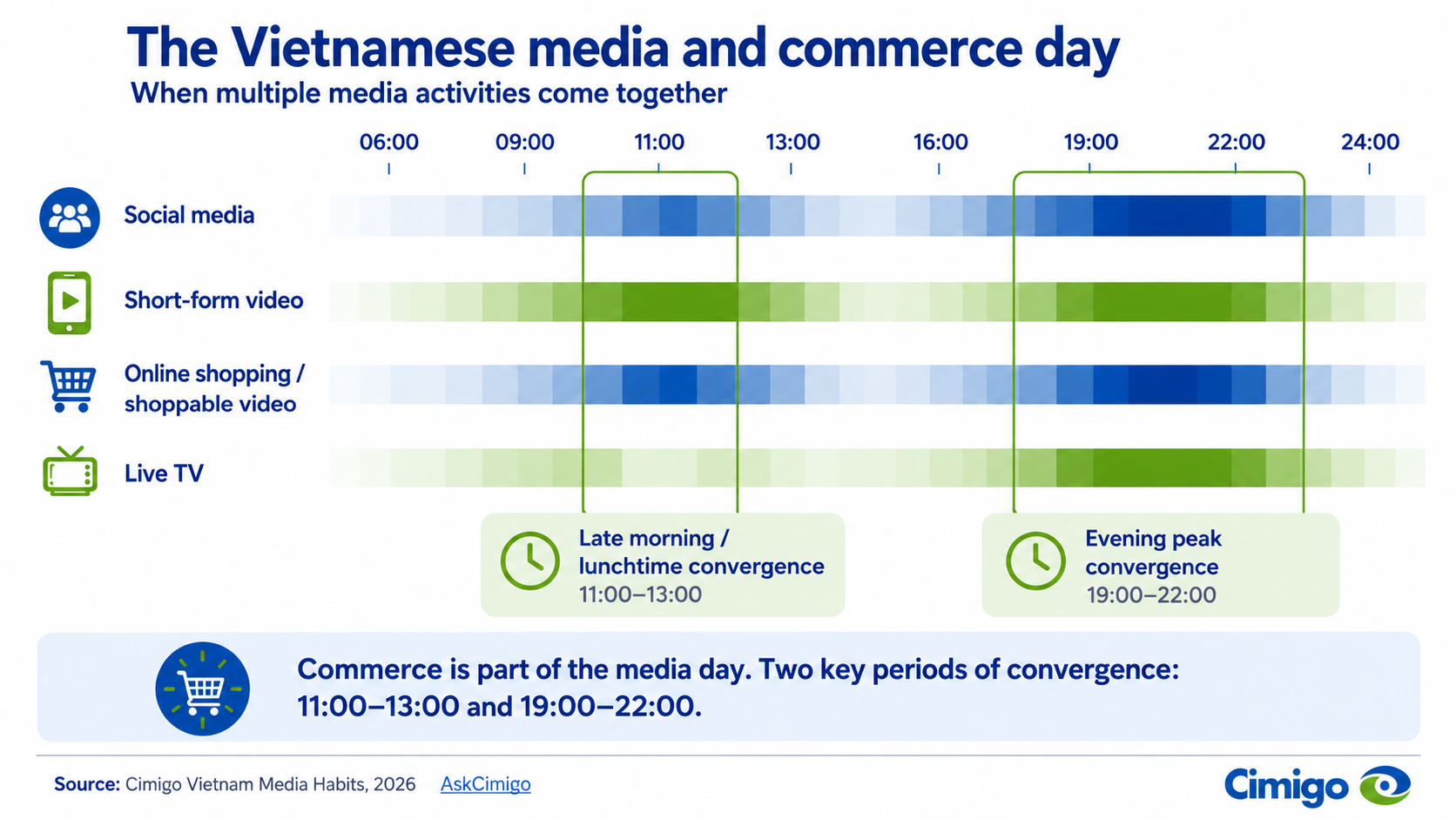
These overlapping activities mean product discovery increasingly takes place within entertainment, social interaction and shopping content rather than through a conventional sequence of advertising followed by retail visits.
Consumers can encounter a product through a creator, compare prices on a marketplace, review customer feedback and complete a purchase within a relatively short period.
This changes the role of marketing. Product information, reviews, creator credibility, pricing, promotions and platform visibility are all potentially important parts of the same purchasing decision.
It also increases the importance of understanding category-specific shopping journeys. Different consumers may rely on different combinations of digital content, physical inspection, retailer advice and personal recommendations.
The Cimigo Vietnam e-commerce 2026 study provides deeper evidence on digital media and shopping behaviour. Among the study’s defined audience of consumers aged 15 to 44 in households earning at least VND 10 million per month, 83% had engaged with online shopping or shoppable video in the previous day. These findings reinforce the need to understand shopping as part of consumers’ wider media routines.
Vietnam’s leading online marketplaces continue to expand, although the economic meaning of this growth requires careful interpretation.
According to YouNet ECI figures referenced in Cimigo’s presentation, gross merchandise value across Shopee, TikTok Shop, Lazada and Tiki reached VND 264.8 trillion during H1 2026.
Shopee accounted for approximately 54.5% of monitored marketplace GMV, while TikTok Shop represented 43.4%. These figures illustrate both the scale and concentration of Vietnam’s online marketplace economy.
However, marketplace GMV is not the same as incremental consumer expenditure. Growth can arise from several different sources:
This distinction matters because a platform can report strong sales growth while the underlying consumer category grows much more slowly.
The YouNet ECI data also indicate a decline in the number of revenue-generating sellers, alongside an increase in average GMV among the remaining active sellers.
Approximately 13% of stores and 8% of sales are cross-border, with imported goods distributed by domestic sellers adding further international competition.
For consumer brands, growing e-commerce participation therefore offers opportunities but also introduces stronger price transparency, competitive intensity and pressure on differentiation.
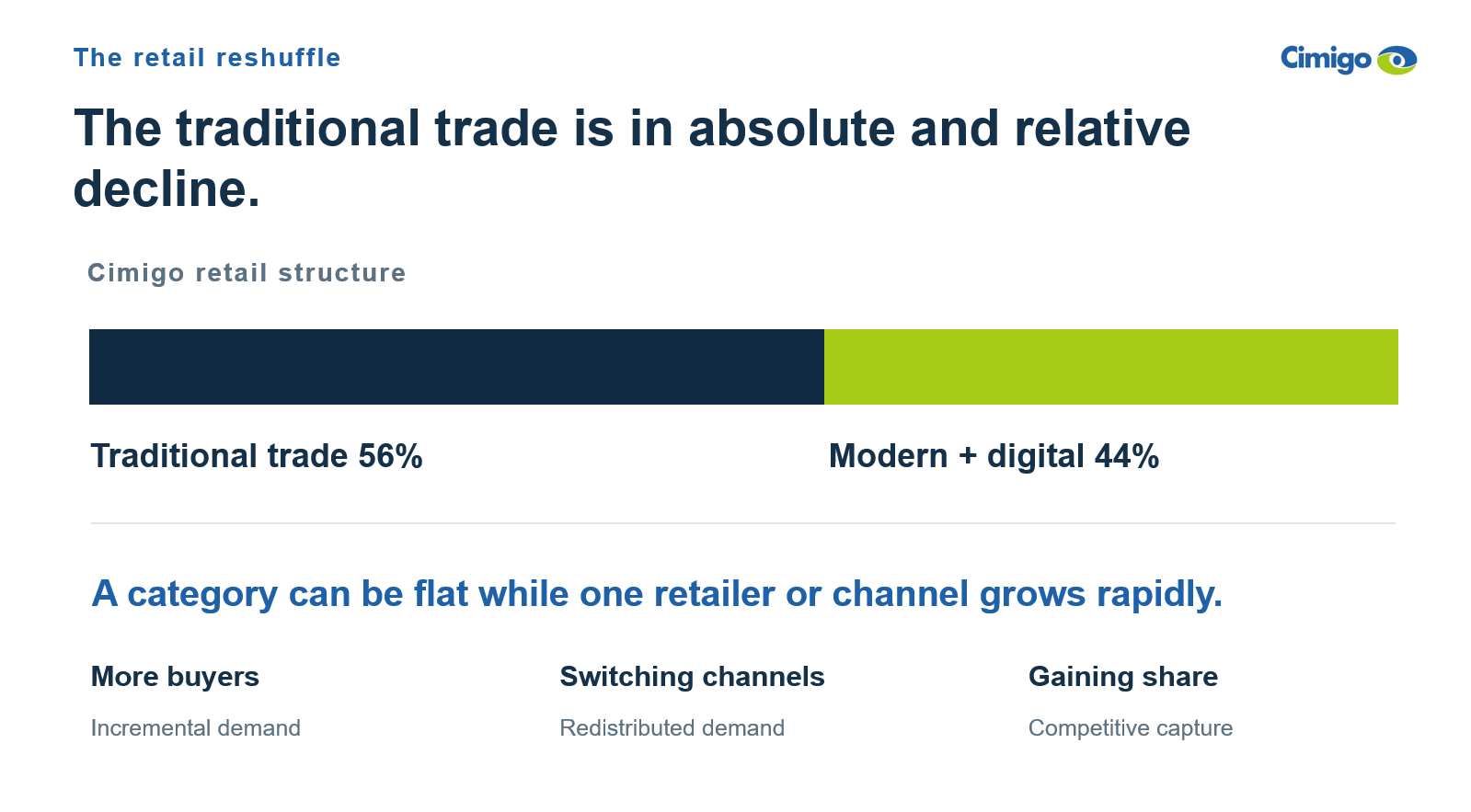
Cimigo’s retail structure estimates indicate that traditional trade accounts for approximately 56% of the market examined, with modern and digital trade together representing around 44%.
Traditional retail remains a substantial part of Vietnam’s consumer economy, particularly for everyday shopping and local convenience. However, its relative importance is declining as consumers increasingly participate in modern retail and digital commerce.
Cimigo identifies a decline in traditional trade’s absolute value, highlighting that channel change may represent more than a redistribution of market share.
For manufacturers and brands, changing retail economics influence product availability, distribution costs, promotion effectiveness, merchandising and customer relationships.
Businesses need to distinguish whether their channel growth comes from genuine category expansion, consumers changing where they shop, or market share gained from competitors.
Without this distinction, companies risk overestimating category opportunities or misallocating distribution and marketing investment.
Vietnam’s transition towards a more digital and formalised economy is also reshaping how businesses operate.
Electronic invoicing, digital payment records and improved tax visibility are increasing the transparency of commercial transactions.
Government figures cited in Cimigo’s presentation indicate that revenue from the non-state economy increased approximately 38% during the first nine months of 2026, while registrations for electronic invoices generated by cash registers increased approximately 70%.
These figures indicate substantial change in administrative visibility and compliance activity. They should not, however, be interpreted directly as equivalent increases in the underlying economic activity of small businesses.
For independent retailers, distributors and household businesses, formalisation may require adjustments to financial reporting, record keeping, payment systems, taxes and operating practices.
Over time, more transparent transactions and improved digital capabilities may contribute to greater productivity and more efficient business relationships. But in the short term, these changes can introduce additional compliance costs and operational friction for many businesses.
For consumer brands, formalisation is therefore relevant to route-to-market planning. Changes in retailer economics may influence distribution structures, credit arrangements, margins and product pricing. Businesses should assess these effects alongside shifts in shopping behaviour, rather than viewing formalisation solely as a regulatory development.
Consumers are not necessarily withdrawing from consumption. Increasingly, they are making sharper choices about where their money delivers the greatest value. Cimigo’s synthesis of consumer behaviour identifies four useful responses to financial pressure and changing purchasing priorities.
Consumers protect spending they consider necessary or difficult to compromise. This includes everyday essentials and products or brands associated with dependable quality and performance.
For businesses, relevance and trust become particularly important where consumers are concerned about the consequences of making a poor purchase.
Consumers may extend replacement cycles, defer major purchases or delay discretionary upgrades.
Home appliances, electronics, furniture and other higher-value categories can be particularly sensitive to this behaviour, although the impact depends on household circumstances and purchase urgency.
Consumers may compare products, promotions, pack sizes, price per use and alternative brands more actively.
Value does not necessarily mean choosing the cheapest product. It means evaluating whether the price is justified by the benefits, quality, convenience or reassurance received.
Financial caution does not remove the desire for enjoyment, convenience or premium experiences.
Consumers can reduce spending in some categories while continuing to reward themselves in others, particularly when the purchase offers a meaningful experience or clear personal benefit.
These behaviours are not mutually exclusive. The same household may protect spending on familiar food brands, postpone replacing an appliance, compare prices for household products and spend on a family outing.
The commercial challenge is to understand which of these behaviours is shaping demand in a particular category, among which consumers and on which purchasing occasions.
Aggregate consumer expenditure continues to grow, despite financial caution and changes in shopping behaviour.
National Statistics Office data cited for Q3 2026 indicates that nominal retail goods revenue increased by 13.4% year on year. Accommodation and food services grew by 19%, while travel services increased by 24%.
| Consumer market sector | Q3 2026 nominal growth, year on year |
|---|---|
| Retail goods | 13% |
| Accommodation and food services | 19% |
| Travel services | 24% |
| Other consumer services | 15% |
| Total retail goods and consumer services | 14% |
Source: Vietnam National Statistics Office, Q3 2026 retail goods and consumer services data. These figures are nominal and include price effects.
These growth rates demonstrate that consumer demand remains substantial. However, they also highlight differences in spending patterns across sectors.
Travel and leisure benefit from demand for experiences, family time and recreation. Healthcare and wellbeing can become more relevant as consumers age and place greater emphasis on quality of life. Education, skills development and convenience services compete for household resources alongside physical goods.
It is important not to interpret faster nominal growth in one service category as proof that all consumer expenditure is moving away from goods. Price increases, recovery from earlier periods, tourism activity and other factors can also influence reported growth.
Nevertheless, the broader strategic implication is clear. Consumer businesses compete for a share of household budgets, not simply for market share within their immediate product categories.
For example, a household allocating more money to travel, education or healthcare may have less available for discretionary household goods, even when its overall spending continues to increase.
Brands therefore need to understand the wider financial and lifestyle priorities influencing their customers, not only the competitive products available within their category.
Vietnam’s consumer outlook for 2027 will be shaped by two sets of forces operating simultaneously.
First, direct financial pressures influence household spending flexibility. These include consumer confidence, essential living costs, borrowing rates, fixed commitments and the desire to maintain precautionary savings.
Second, structural changes redistribute demand. Population ageing, falling birth rates, digital commerce, retail transformation, economic formalisation and changing preferences influence which categories and channels attract expenditure.
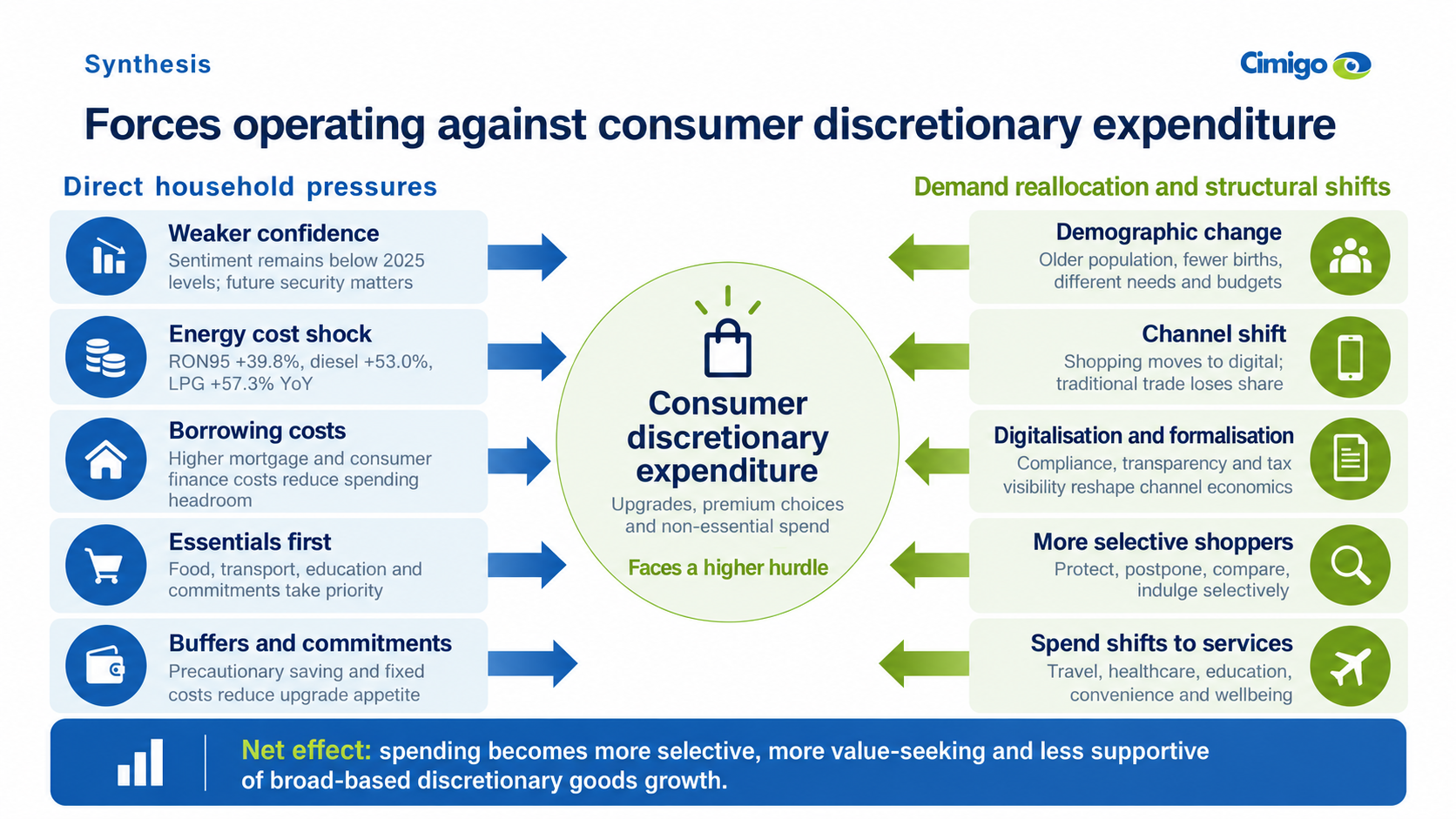
These forces help explain why strong national economic growth can coexist with cautious purchasing behaviour, uneven category performance and considerable variation in business results.
The implications are not uniformly negative. Demographic change can open new markets. Digital commerce provides different routes to consumers. Higher productivity and infrastructure investment may support future purchasing power.
However, the sources of opportunity are becoming more specific.
Growth in 2027 is more likely to reward businesses that understand changing consumer needs, defend their perceived value, and allocate resources to the right customers, occasions, and channels.
Businesses should avoid treating Vietnam’s national GDP growth forecast as a proxy for their own sales growth.
A more defensible commercial plan begins with category demand, customer behaviour, purchasing frequency, pricing and competitive position.
Cimigo recommends using alternative demand environments to test commercial plans rather than relying on a single optimistic growth assumption.
Confidence remains subdued. Household commitments restrict discretionary spending and consumers seek demonstrable value.
Protect profitable volume, retention, cash flow and competitive availability. Review promotional efficiency and value propositions.
Consumer confidence recovers selectively, with demand improving among particular household groups and categories.
Invest in attractive segments, assess emerging purchase occasions and test innovation before scaling investment.
Household financial confidence and purchasing capacity improve across a broader range of consumer segments.
Expand distribution, product portfolios and marketing investment where category evidence demonstrates sustainable demand.
These are planning scenarios, not quantified predictions. Their value lies in making assumptions explicit and identifying the evidence that would justify changing investment decisions.
Useful indicators include consumer sentiment, real household income, category purchase incidence, buying frequency, volume growth, achieved selling prices, promotional dependence and changes in retail channels.
For consumer businesses, four practical questions provide a more useful starting point than GDP growth alone.
Together, these drivers help organisations separate market expansion from changes in purchasing behaviour and competitive performance.
For example, a brand achieving 15% revenue growth might be benefiting from additional buyers, higher purchasing frequency, price increases, channel gains or a combination of these factors.
Each source of growth has different implications for future sustainability, margins and marketing investment.
Even a category which is growing slowly in value may contain attractive opportunities within particular consumer segments, price tiers or purchasing occasions.
The objective is to explain where sales growth will actually come from, rather than assuming that broader economic expansion will deliver it.
Macroeconomic data provides essential context, but business decisions require a closer understanding of customers and markets.
Consumer research can help organisations distinguish between several questions that are easily confused in aggregate data.
Category penetration, purchasing frequency, purchase volumes and expenditure trends.
Consumer confidence, household financial priorities, value perceptions and unmet needs.
Segmentation by behaviour, life stage, income, household needs and purchasing occasions.
Brand penetration, switching, channel participation, shopper behaviour and competitive share.
Price sensitivity, perceived value, competitive alternatives and response to promotional activity.
Demand scenarios, concept validation, channel analysis and evidence-based commercial forecasting.
Research is most useful when it connects changes in the market with specific management decisions.
For example, if sales are weakening, a business needs to establish whether the cause is declining category consumption, lower purchase frequency, customers switching brands, changes in retail channels or weaker availability.
Each explanation suggests a different response.
This is why a combination of consumer research, retail intelligence, market analysis and business performance data is more informative than any single economic indicator.
Cimigo helps organisations make better choices through consumer and market research, including research designed to understand purchasing behaviour, identify growth opportunities and inform commercial strategy. For businesses requiring accessible existing consumer intelligence, AskCimigo provides research reports and market insights covering important developments in Vietnam.
Vietnam enters 2027 with substantial economic momentum. Manufacturing, investment, exports and infrastructure development are supporting impressive growth, and the country’s longer-term economic potential remains considerable.
Yet the relationship between economic growth and consumer expenditure is becoming more complex.
Consumer confidence has recovered from its Q2 2026 low but remains below 2025 levels. Essential household costs and borrowing commitments influence discretionary spending. Population ageing and lower birth rates are changing purchasing needs, while digital commerce and retail transformation are redistributing consumer expenditure across channels.
Consumers continue to spend, but they are making more selective decisions about which products, services and experiences deserve a place in their budgets.
For businesses, the consequence is a more demanding planning environment. National economic growth remains an important indicator, but it cannot substitute for evidence about customer needs, category demand, channel participation and competitive position.
The defining question for 2027 is not how quickly Vietnam’s economy will grow. It is how that growth will reach your customers, influence their purchasing decisions and translate into sustainable revenue for your business.
Cimigo helps businesses answer these questions through consumer research, market intelligence and commercially focused analysis in Vietnam.
Explore Cimigo’s market research solutions or access consumer intelligence through AskCimigo. If you have any questions or specific needs, please get in touch with us at ask@cimigo.com.
GDP measures economic output, including investment, manufacturing and exports. Consumer spending depends on household purchasing power, confidence, essential costs, borrowing commitments and financial priorities. When growth is concentrated in capital-intensive industries, consumer businesses may not experience the same rate of expansion.
Vietnam’s real GDP increased by 9.95% year on year in Q3 2026, according to the National Statistics Office figures used in Cimigo’s analysis. Manufacturing contributed 3.19 percentage points to GDP growth, the largest individual sector contribution.
Cimigo’s Consumer Profiles research recorded positive consumer sentiment of approximately 53% in Q1 2026, falling to 41% in Q2 before recovering to 54% in Q3. Despite the recovery, sentiment remained below the levels recorded throughout 2025.
Important developments include greater value-conscious purchasing, financial caution, population ageing, changing family structures, increasing participation in digital commerce, and shifts in expenditure across goods, services and experiences. Their effects differ by consumer segment, category and purchasing occasion.
E-commerce is changing product discovery, price comparison, brand evaluation and purchasing. Growth is concentrated among major marketplaces, while traditional retail faces structural pressure. Some online growth represents new demand, but some reflects consumers switching channels or merchants rather than an increase in total consumption.
The outlook depends on household purchasing confidence, real incomes, borrowing costs and category-specific demand. Some consumer segments and sectors may improve faster than others. Businesses should prepare alternative demand scenarios and monitor evidence of purchasing behaviour rather than assume a uniform recovery.
Businesses should forecast category buyers, purchasing frequency, spending per purchase and expected brand share. These assumptions should be tested against changes in consumer confidence, prices, purchasing channels and competitive activity. GDP growth is useful economic context, but it should not be the sole basis for revenue targets.


Vietnam’s consumer outlook 2027
Oct 14, 2026
Vietnam’s consumer outlook 2027: Why strong economic growth does not guarantee consumer
The Road to Saigon
Apr 15, 2025
Watch the Road to Saigon and learn about the stories of the residents. Understand their lives,

Vietnam uninterrupted: a twenty-year journey
Mar 18, 2024
Trends in Vietnam: Vietnam uninterrupted: a twenty-year journey Trends in Vietnam. Witness

Đoàn Ngọc Huy (Johnny Doan), CMO & Market Research Expert -
As a Marketing Director and Market Research Expert Advisor across international markets, I have collaborated with numerous market research agencies, both global and local, that operate with a high level of professionalism and effectiveness. Cimigo is among the most outstanding. The Cimigo team demonstrates exceptional professionalism, strong commitment, and operational excellence. From research design and fieldwork execution to insight analysis, all stages are conducted rigorously, delivered on schedule, and closely aligned with business objectives. This is a highly capable team that I would confidently recommend to my partners and stakeholders.
As a Marketing Director and Market Research Expert Advisor across international markets, I have collaborated with numerous market research agencies, both global and local, that operate with a high level of professionalism and effectiveness. Cimigo is among the most outstanding. The Cimigo team demonstrates exceptional professionalism, strong commitment, and operational excellence. From research design and fieldwork execution to insight analysis, all stages are conducted rigorously, delivered on schedule, and closely aligned with business objectives. This is a highly capable team that I would confidently recommend to my partners and stakeholders.

Lisa Nguyen - Vietnam Marketing Lead

Mark Ratcliff - Managing Director
The team at Cimigo are my favourite researchers in South East Asia. They’ve proved adept at tackling the most private and complex personal issues at qualitative research level, not flinching when the client endlessly chopped and changed fieldwork timing, or ramped up the workload without warning. They have recruited the most extraordinarily niche consumers without pause or complaint. Their patience with clients and their flexibility and hard work that went above and beyond what was initially asked of them on two projects relating to sexual behaviour means there is now no other research company we would choose to work with in that part of Asia. The fact they also pulled off a third project for us so well, on men’s relationship with beer and beer advertising, shows they have breadth of expertise— we still quote from the report they produced.
The team at Cimigo are my favourite researchers in South East Asia. They’ve proved adept at tackling the most private and complex personal issues at qualitative research level, not flinching when the client endlessly chopped and changed fieldwork timing, or ramped up the workload without warning. They have recruited the most extraordinarily niche consumers without pause or complaint. Their patience with clients and their flexibility and hard work that went above and beyond what was initially asked of them on two projects relating to sexual behaviour means there is now no other research company we would choose to work with in that part of Asia. The fact they also pulled off a third project for us so well, on men’s relationship with beer and beer advertising, shows they have breadth of expertise— we still quote from the report they produced.

Kevin McQuillan - Chief Marketing Officer

Sam Houston - Chief Executive Officer

Minh Thu - Consumer Market Insights Manager

Travis Mitchell - Executive Director

Malcolm Farmer - Managing Director

Hy Vu - Head of Research Department

Joe Nelson - New Zealand Consulate General
Steve Kretschmer - Executive Director
York Spencer - Global Marketing Director

Laura Baines - Programmes Snr Manager

Mai Trang - Brand Manager of Romano

Hanh Dang - Product Marketing Manager

Luan Nguyen - Market Research Team Leader
Max Lee - Project Manager

Chris Elkin - Founder

Ronald Reagan - Deputy Group Head After Sales & CS Operation
Chad Ovel - Partner

Private English Language Schools - Chief Executive Officer
Rick Reid - Creative Director

Anya Nipper - Project Coordination Director

Dr. Jean-Marcel Guillon - Chief Executive Officer

Joyce - Pricing Manager

Matt Thwaites - Commercial Director

Aashish Kapoor - Head of Marketing

Kelly Vo - Founder & Host

Thanyachat Auttanukune - Board of Management

Hamish Glendinning - Business Lead

Thuy Le - Consumer Insight Manager

Richard Willis - Director

Ha Dinh - Project Lead
Geert Heestermans - Marketing Director

Vo Thi Thuy Ha - Commercial Effectiveness

Louise Knox - Consumer Technical Insights

Aimee Shear - Senior Research Executive
Dennis Kurnia - Head of Consumer Insights
Tania Desela - Senior Product Manager
Thu Phung - CTI Manager
Linda Yeoh - CMI Manager

 Team
Team
Cimigo’s market research team in Vietnam and Indonesia love to help you make better choices.
 Solutions
Cimigo provides market research solutions in Vietnam and Indonesia that will help you make better choices.
 Trends
Cimigo provides a range of consumer marketing trends and market research on market sectors and consumer segments in Vietnam and Indonesia.
 Reports
Cimigo provides a range of free market research reports on market sectors and consumer segments in Vietnam and Indonesia.