8 tips for HR managers to improve employee experience management
Sep 30, 2026
Employee experience (EX) has quickly become a defining element of organisational success,

8 tips for HR managers to improve employee experience management
 Tram Ta
 Sep 30, 2026
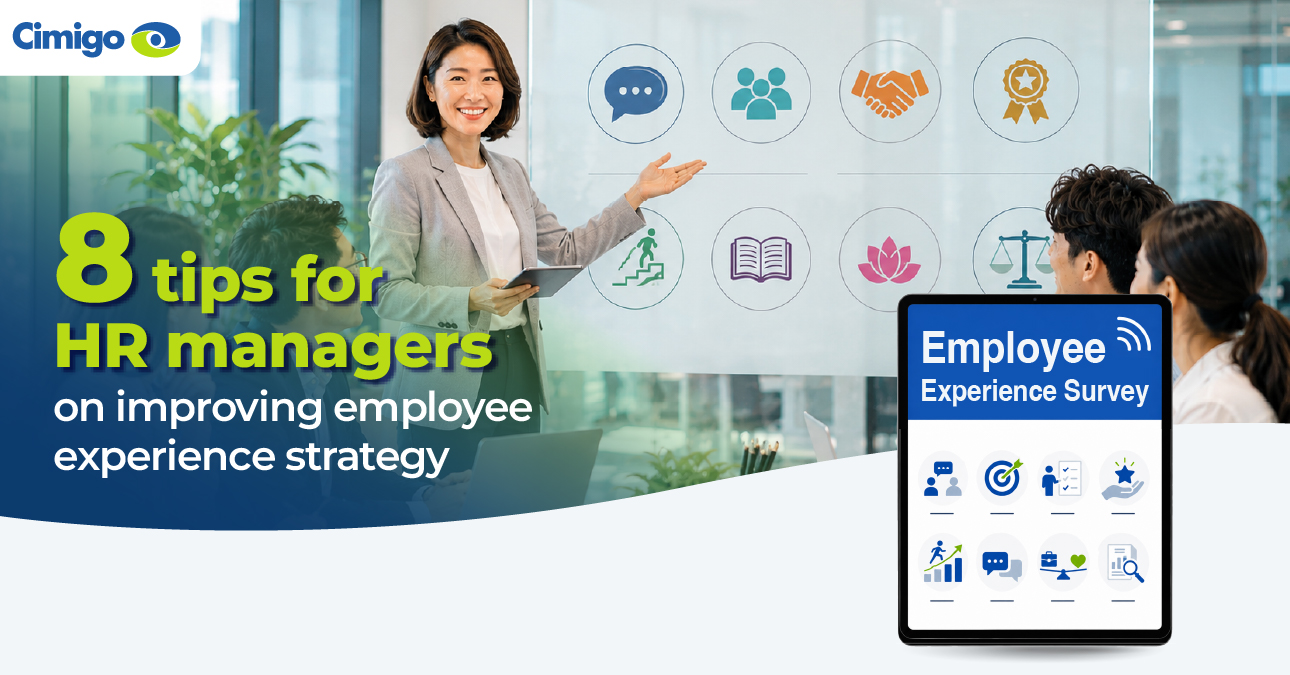
Employee experience (EX) has quickly become a defining element of organisational success, particularly in Vietnam’s fast-growing and increasingly competitive talent landscape. As younger generations enter the workforce with higher expectations and greater digital fluency, companies can no longer rely on salary alone to retain their best people. Instead, human resources leaders need to shift from reactive tactics towards proactive employee experience management. Organisations that prioritise EX, monitor employee satisfaction and continuously improve the workplace experience are better positioned to foster loyalty, encourage innovation and support stronger performance across the business.
Here are eight practical tips that HR managers can use to strengthen employee experience management and improve employee satisfaction in Vietnam, drawing on case studies and research-based approaches, including Cimigo’s Employee Experience Survey.
The first step in improving employee experience is understanding how employees actually feel. HR professionals need regular and safe channels for feedback, not only at exit interviews but as part of ongoing employee experience management.
Cimigo’s Employee Experience Survey enables organisations to gather anonymous and honest feedback across departments in just 10 days. For example, a Hanoi-based logistics firm used the survey during a leadership transition and discovered that 62% of staff were confused about the organisation’s direction, significantly reducing employee satisfaction. Clearer communication strategies, introduced as part of a revised employee experience management approach, led to a 28% rise in overall employee satisfaction.
Actionable tip: Share a summary of the survey results and resulting action plans with employees. This helps build trust and demonstrates that feedback leads to action.
Today’s workforce spans several generations, each with different expectations that can influence employee satisfaction. Gen Z may value autonomy and rapid feedback, while Gen X may place greater emphasis on job stability and long-term impact. In Vietnam, where traditional values of respect coexist with modern ambitions, employee experience research needs to reflect this diversity.
A financial services firm segmented Cimigo’s survey results by generation and found significant differences in employee priorities. As a result, the company customised mentorship programmes for younger staff, flexible options for millennials and recognition programmes for senior employees, increasing company-wide engagement and overall employee satisfaction by 22%.
Actionable tip: Use segmentation tools in your survey results dashboard to compare employee experience by role, age, tenure and region, then develop action plans that reflect the needs of different employee groups.
Many Vietnamese employees may hesitate to speak openly because of hierarchical workplace norms, making it harder to understand their true level of satisfaction. Building psychological safety into employee experience management creates an environment where employees feel able to share concerns and ideas more openly.
Cimigo’s anonymous survey platform allows team members to provide feedback without fear of bias. In one case, more than 70% of employees reported sharing openly about their employee satisfaction for the first time. This level of candid feedback helped leadership identify and address concerns that had previously remained hidden.
Actionable tip: Remind employees that their survey responses are anonymous. Using a trusted third-party survey provider can reinforce this assurance and encourage more honest feedback.
Sometimes the apparent problem is not the underlying issue. A leading Vietnamese retail chain assumed that high staff turnover and declining employee satisfaction were caused by compensation. Survey data revealed a different problem: employees felt unsupported and unclear about their career development opportunities.
Instead of increasing pay, the company adjusted its employee experience management approach by introducing coaching initiatives and clearer promotion criteria. Within six months, employee satisfaction improved significantly, turnover fell by 18% and employee NPS increased.
Actionable tip: Look beyond the obvious symptoms. Ask whether employees feel valued, supported, guided and sufficiently challenged, then use the findings to identify the issues that require action.
Modern employee experience management extends beyond financial benefits. Well-being, particularly mental and emotional support, can influence employee performance, retention and satisfaction.
One F&B company used Cimigo’s survey to measure employee perceptions of workplace well-being and current levels of satisfaction. The results revealed low awareness of the support already available. By incorporating wellness days, manager training and workload planning into its employee experience management, the company increased work-life satisfaction by 28 points.
Actionable tip: Do not assume that well-being initiatives are working as intended. Ask employees directly, measure their experience and adjust programmes based on the findings.
Successful employee experience management is not solely the responsibility of HR. Senior leaders also need to support the programme and act on employee feedback. When leadership visibly responds to employees’ concerns, it can strengthen trust and reinforce the importance of the employee experience across the organisation.
Cimigo’s analysis and dashboard simplify this process by providing leadership with clear summaries that can guide employee experience management. At a startup in Da Nang, even relatively small changes, such as introducing peer review tools, led to a near 40% rise in job satisfaction within six months.
Actionable tip: Involve department heads in employee experience management and give them clear responsibility for addressing the issues identified within their teams.

One of the quickest ways to undermine employee experience management is to ask employees for feedback and then do nothing with it. Feedback should lead to visible action wherever appropriate.
Communicate what employees have told you and explain what will change as a result. Employees may not expect every issue to be resolved immediately, but they do expect transparency and evidence that their feedback has been considered.
Actionable tip: After each survey, consider a “You said, we did” communication to explain the actions taken in response to employee feedback.

Vietnamese employees may value aspects of the workplace differently from employees in other markets. Community, family and shared purpose can be important alongside individual recognition. While global HR trends provide useful context, employee experience management should reflect the local working environment and cultural context.
Cimigo’s platform supports cultural nuances, bilingual formats and regional adaptations. This helps organisations measure and improve employee experience in a way that is relevant to their workforce.
Actionable tip: Use local language and relevant internal examples when communicating with employees, and ensure that employee experience programmes reflect the context in which employees actually work.
In Vietnam’s competitive workplace environment, effective employee experience management and improving employee satisfaction are important business priorities. HR managers can make better decisions by moving from assumptions towards evidence and from instinct towards insight.
By listening to employees, analysing different employee groups and taking targeted action aligned with company values, organisations can improve employee satisfaction, reduce turnover, strengthen loyalty and build a workforce that is more engaged in the organisation’s success.
Cimigo’s Employee Experience Survey helps organisations in Vietnam turn employee feedback into practical evidence for decision-making.
Visit www.cimigo.com or email us at ask@cimigo.com for support.

8 tips for HR managers to improve employee experience management
Sep 30, 2026
Employee experience (EX) has quickly become a defining element of organisational success,

Vietnam consumer trends 2026
Feb 05, 2026
Vietnam is still a growth market, but consumer trends 2026 show that it has matured faster than

Indonesia consumer trends 2025
May 11, 2025
Indonesia consumer trends 2025 highlights eight key reasons why Indonesia is poised for a rebound.
Đoàn Ngọc Huy (Johnny Doan), CMO & Market Research Expert -
As a Marketing Director and Market Research Expert Advisor across international markets, I have collaborated with numerous market research agencies, both global and local, that operate with a high level of professionalism and effectiveness. Cimigo is among the most outstanding. The Cimigo team demonstrates exceptional professionalism, strong commitment, and operational excellence. From research design and fieldwork execution to insight analysis, all stages are conducted rigorously, delivered on schedule, and closely aligned with business objectives. This is a highly capable team that I would confidently recommend to my partners and stakeholders.
As a Marketing Director and Market Research Expert Advisor across international markets, I have collaborated with numerous market research agencies, both global and local, that operate with a high level of professionalism and effectiveness. Cimigo is among the most outstanding. The Cimigo team demonstrates exceptional professionalism, strong commitment, and operational excellence. From research design and fieldwork execution to insight analysis, all stages are conducted rigorously, delivered on schedule, and closely aligned with business objectives. This is a highly capable team that I would confidently recommend to my partners and stakeholders.
Lisa Nguyen - Vietnam Marketing Lead
Mark Ratcliff - Managing Director
The team at Cimigo are my favourite researchers in South East Asia. They’ve proved adept at tackling the most private and complex personal issues at qualitative research level, not flinching when the client endlessly chopped and changed fieldwork timing, or ramped up the workload without warning. They have recruited the most extraordinarily niche consumers without pause or complaint. Their patience with clients and their flexibility and hard work that went above and beyond what was initially asked of them on two projects relating to sexual behaviour means there is now no other research company we would choose to work with in that part of Asia. The fact they also pulled off a third project for us so well, on men’s relationship with beer and beer advertising, shows they have breadth of expertise— we still quote from the report they produced.
The team at Cimigo are my favourite researchers in South East Asia. They’ve proved adept at tackling the most private and complex personal issues at qualitative research level, not flinching when the client endlessly chopped and changed fieldwork timing, or ramped up the workload without warning. They have recruited the most extraordinarily niche consumers without pause or complaint. Their patience with clients and their flexibility and hard work that went above and beyond what was initially asked of them on two projects relating to sexual behaviour means there is now no other research company we would choose to work with in that part of Asia. The fact they also pulled off a third project for us so well, on men’s relationship with beer and beer advertising, shows they have breadth of expertise— we still quote from the report they produced.

Kevin McQuillan - Chief Marketing Officer

Sam Houston - Chief Executive Officer
Minh Thu - Consumer Market Insights Manager

Travis Mitchell - Executive Director
Malcolm Farmer - Managing Director

Hy Vu - Head of Research Department

Joe Nelson - New Zealand Consulate General
Steve Kretschmer - Executive Director
York Spencer - Global Marketing Director

Laura Baines - Programmes Snr Manager

Mai Trang - Brand Manager of Romano

Hanh Dang - Product Marketing Manager
Luan Nguyen - Market Research Team Leader
Max Lee - Project Manager

Chris Elkin - Founder
Ronald Reagan - Deputy Group Head After Sales & CS Operation
Chad Ovel - Partner

Private English Language Schools - Chief Executive Officer

Rick Reid - Creative Director

Anya Nipper - Project Coordination Director

Dr. Jean-Marcel Guillon - Chief Executive Officer

Joyce - Pricing Manager

Matt Thwaites - Commercial Director
Aashish Kapoor - Head of Marketing

Kelly Vo - Founder & Host
Thanyachat Auttanukune - Board of Management
Hamish Glendinning - Business Lead

Thuy Le - Consumer Insight Manager
Richard Willis - Director

Ha Dinh - Project Lead
Geert Heestermans - Marketing Director
Vo Thi Thuy Ha - Commercial Effectiveness

Louise Knox - Consumer Technical Insights

Aimee Shear - Senior Research Executive
Dennis Kurnia - Head of Consumer Insights
Tania Desela - Senior Product Manager
Thu Phung - CTI Manager
Linda Yeoh - CMI Manager

 Team
Team
Cimigo’s market research team in Vietnam and Indonesia love to help you make better choices.
 Solutions
Cimigo provides market research solutions in Vietnam and Indonesia that will help you make better choices.
 Trends
Cimigo provides a range of consumer marketing trends and market research on market sectors and consumer segments in Vietnam and Indonesia.
 Reports
Cimigo provides a range of free market research reports on market sectors and consumer segments in Vietnam and Indonesia.