

Mystery shopping services in Vietnam and Indonesia
Mystery shopping is a customer experience research methodology that uses trained researchers to evaluate real customer interactions across physical and digital channels. It helps organisations understand how customers experience their brand, benchmark competitors, improve service quality and identify operational improvements.
Cimigo can help you make better choices for your retail execution. Staff on the frontline can make a huge difference to sales and brand perceptions; both positive and negative. Cimigo’s mystery shopping team can be deployed to assess that performance and to identify areas to improve. Cimigo’s mystery shoppers use the Cimigo OnMobile application to report findings instantly and easily.
Cimigo do not only assess whether staff met standards in terms of uniform or other functional aspects. Cimigo’s team assesses the frontline capability to positively engage customers and their knowledge of brand and service. Cimigo’s results feed into programmes that drive performance, survey training, protocols to follow and innovations to simplify the customer journey.
Typically, studies investigate;
-

Independent observation of performance based standard metrics for improvement. -
Comparison across store type and area. -

Front line staff performance. -

Stock and facility standards. -

Range, facing, servicing, pricing and display compliance. -

Environment standards. -

Task based assessments. -

Identify and showcase best performers. -

Identify problem areas. -

Qualitative feedback from mystery shoppers. -

Actions to improve.
Unlike customer satisfaction research, which measures customer perceptions, mystery shopping objectively evaluates customer interactions. When combined with customer satisfaction research, Voice of Customer programmes and customer journey mapping, it provides a comprehensive understanding of customer experience.
For organisations operating in Vietnam and Indonesia, mystery shopping supports better decision-making by identifying opportunities to improve customer experience, strengthen operational consistency and adapt to changing customer expectations.

Key takeaways
- Mystery shopping measures real customer experiences rather than customer opinions.
- It supports customer experience, sales, compliance and operational improvement.
- The methodology is valuable across banking, insurance, automotive, retail, hospitality and QSR.
- Modern programmes evaluate both physical and digital customer journeys.
- The greatest value comes from combining mystery shopping with broader customer and market research.
- Local market knowledge is essential for designing meaningful customer scenarios in Vietnam and Indonesia.
Understand what your customers really experience.
Customer expectations have never been higher. Customer experience has become one of the few sustainable competitive advantages for organisations. As Harvard Business Review has consistently highlighted, leading organisations increasingly compete on the experiences they deliver rather than products or price alone. Mystery shopping helps organisations understand whether they are consistently delivering those experiences.
Whether opening a bank account, purchasing a new vehicle, discussing an insurance policy or ordering dinner through a mobile app, customers expect every interaction to be fast, knowledgeable, transparent and consistent.
For organisations, delivering that experience across hundreds of branches, dealerships, outlets and digital channels is becoming increasingly difficult. Products are easier to copy, prices are more transparent and digital technology has raised expectations across every industry. As a result, customer experience has become one of the few sustainable competitive advantages.
The challenge is that many organisations don’t actually know what customers experience.
Internal reports measure operational performance. Customer satisfaction surveys capture perceptions after an interaction. CRM systems record transactions.
But none of these methods objectively answer a simple question:
What actually happens when a customer interacts with our business?
This is where mystery shopping provides value.
Mystery shopping is a market research methodology that evaluates real customer interactions against predefined service, sales and operational standards. It provides independent evidence of how customers experience an organisation across physical and digital channels, helping businesses identify opportunities to improve customer experience, strengthen operational performance and benchmark competitors.
At Cimigo, we see mystery shopping as one part of a broader customer experience research programme. When combined with customer satisfaction research, Voice of Customer programmes and customer journey mapping, it helps organisations understand both what customers experience and why they experience it.
For businesses operating in Vietnam and Indonesia, this perspective is particularly valuable. Both markets continue to experience rapid digital transformation, changing consumer expectations and increasing competition. Organisations that understand these changes are better positioned to improve customer experience and build long-term competitive advantage.
These changes are not occurring in isolation. Cimigo’s latest Vietnam Consumer Trends and Indonesia Consumer Trends explore how digital adoption, financial inclusion, retail transformation and rising household affluence are reshaping customer expectations across multiple industries.
What is mystery shopping?
Mystery shopping is a market research methodology that uses trained researchers to evaluate customer interactions anonymously, following realistic customer scenarios and predefined evaluation criteria.
Unlike operational audits, mystery shopping assesses the customer journey from the customer’s perspective.
Researchers may:
- Visit a retail store.
- Open a bank account.
- Request an insurance quotation.
- Arrange a vehicle test drive.
- Contact a customer service centre.
- Use live chat or WhatsApp.
- Purchase through a mobile application.
Each interaction is assessed against agreed objectives, which may include customer experience, sales effectiveness, operational execution, regulatory compliance or competitor benchmarking.
Rather than focusing on individual employees, mystery shopping identifies patterns across locations, customer journeys and channels. These insights help organisations improve service standards, coach frontline teams, and make better business decisions.
As a market research methodology, mystery shopping should be designed and conducted in accordance with recognised professional and ethical standards. Organisations should ensure programmes protect participant confidentiality, avoid unfairly targeting individual employees and comply with accepted market research practices, such as those promoted by ESOMAR.
As customer journeys become increasingly digital, modern mystery shopping programmes often evaluate the complete omnichannel experience rather than a single interaction.
Mystery shopping versus other customer experience research methods
One of the most common misconceptions is that mystery shopping replaces customer satisfaction research. In reality, each methodology answers different business questions.
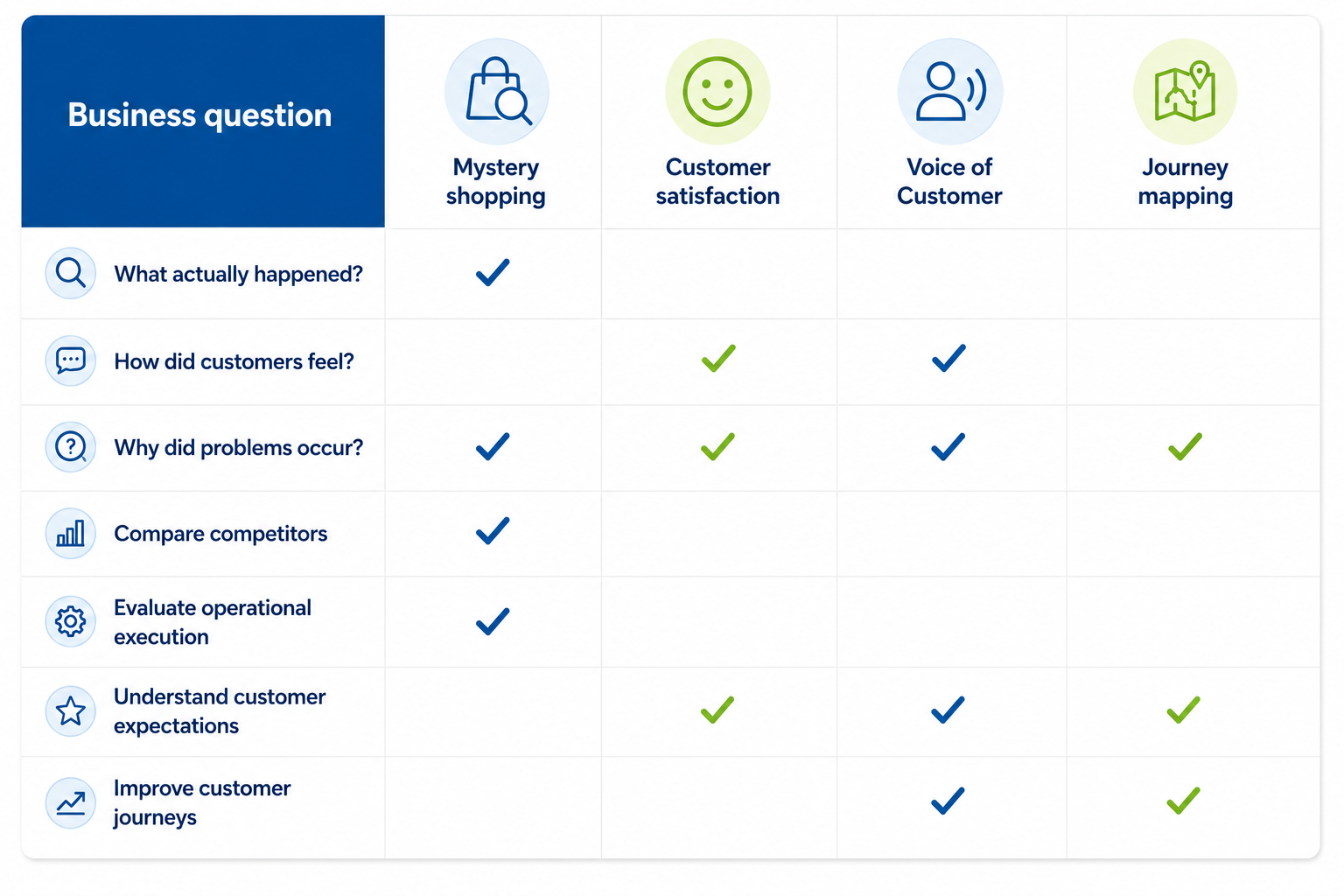
No single methodology provides a complete picture. For example, a customer may report being satisfied after opening a bank account, while mystery shopping reveals that key product features were never explained. Equally, a customer may leave dissatisfied after a loan application is declined, even though the adviser handled the conversation professionally and followed every required process.
The greatest value comes from combining multiple research methodologies to understand both customer perceptions and observed behaviours.
Cimigo insight
Organisations rarely improve customer experience through a single research methodology. Combining mystery shopping with customer satisfaction research, Voice of Customer programmes and customer journey mapping provides a richer understanding of customer behaviour and supports better business decisions.
Explore related expertise:
- Employee experience research.
- Customer experience research.
- Relevant customer experience articles on Cimigo.
Why organisations use mystery shopping
Many organisations begin by monitoring service standards or evaluating compliance. The most successful organisations use it for something much bigger. They use mystery shopping to answer strategic questions about customer experience. For example:
- Are customers receiving consistent service across every location?
- Are digital channels delivering the same experience as physical branches?
- How do competitors create better customer experiences?
- Which frontline behaviours build customer confidence?
- Are new service initiatives actually improving customer experience?
- Where should coaching and operational improvements be prioritised?
Rather than producing another performance score, mystery shopping provides objective evidence that supports continuous improvement. Common applications include:
- Improving customer experience.
- Evaluating sales effectiveness.
- Monitoring operational consistency.
- Assessing regulatory compliance.
- Benchmarking competitors.
- Supporting employee coaching.
- Measuring omnichannel customer journeys.
- Evaluating franchise and dealer performance.
As organisations increasingly compete on customer experience rather than product alone, this has become an important strategic research tool rather than simply an operational audit.
How a successful mystery shopping programme works
Effective programmes begin long before the first customer visit. The quality of the insights depends on the quality of the research design. At Cimigo, every programme begins by understanding the business decisions the research is intended to support. From there, realistic customer scenarios are developed to reflect genuine customer journeys rather than artificial tests. For example:
- A bank may evaluate first-time home buyers seeking mortgage advice.
- An insurer may assess how advisers explain policy exclusions.
- An automotive manufacturer may evaluate electric vehicle consultations.
- A restaurant chain may measure consistency between dine-in, takeaway and delivery experiences.
Researchers are carefully selected to reflect the target customer profile and receive a detailed briefing to ensure consistency.
Today’s customer journeys frequently include multiple channels, so mystery shopping often evaluates:
- Websites.
- Mobile applications.
- Live chat.
- WhatsApp.
- Zalo.
- Contact centres.
- Physical locations.
- Follow-up communications.
The final stage is analysis. Rather than simply producing league tables, effective reporting identifies behavioural patterns, operational strengths and customer journey friction points that can inform practical improvements. That is where a porgramme moves beyond measurement and becomes a tool for continuous improvement.
Where mystery shopping creates the greatest business value
Mystery shopping follows the same core methodology across industries, but the business questions it answers vary.
A bank needs to balance personalised advice with regulatory compliance. An automotive manufacturer wants to deliver a seamless journey from online research to vehicle ownership. An insurer depends on customer trust and transparent advice, while a restaurant chain succeeds through consistency and operational discipline.
The most successful programmes are designed around these business challenges, rather than a standard checklist of service measures.
Mystery shopping for banks
The challenge
Banking has become one of the most competitive sectors in Southeast Asia for customer experience. Digital banking has made routine transactions easier than ever, but it has also raised customer expectations. Today’s customers expect seamless digital experiences while still valuing expert advice for more complex products such as mortgages, investments and business banking.
For banks, the challenge is delivering consistent, high-quality advice across branches, contact centres and digital channels while maintaining regulatory compliance and building customer trust.

Where mystery shopping creates value
It helps banks understand whether customers experience the service the organisation intends to deliver.
Typical applications include:
- Evaluating branch service quality and relationship management.
- Assessing digital account opening and onboarding journeys.
- Reviewing the quality of needs-based financial conversations.
- Measuring how clearly products, fees and risks are explained.
- Comparing customer experiences across branches and regions.
- Benchmarking competitors.
- Identifying coaching opportunities for frontline teams.
Rather than simply confirming whether procedures were followed, mystery shopping helps identify the behaviours that build customer confidence and long-term relationships.
Market perspective
Vietnam’s banking sector continues to invest heavily in digital transformation, while branches remain central to advisory conversations for higher-value financial products. Our research into Vietnam retail banking explores how digital transformation, customer experience and changing competitive dynamics are reshaping the industry.
Mystery shopping helps banks understand whether digital convenience is complemented by knowledgeable, transparent advice when customers seek personal support. Customer expectations continue to evolve rapidly in Vietnam’s banking sector.
Indonesia presents a different challenge. Alongside conventional banking, Islamic banking plays an important role, requiring customer journeys that reflect Sharia-compliant products and different customer expectations. The country’s geographic scale also makes consistency across large branch networks a continuing operational priority.
Across both markets, mystery shopping provides an objective and consistent way to evaluate the customer experience while accounting for local market dynamics.
Cimigo insight
Customer expectations in banking continue to evolve as digital adoption accelerates and competition extends beyond traditional banks. Mystery shopping provides operational evidence, while broader market research explains the changing expectations behind customer behaviour.
Related Cimigo research:
Vietnam Retail Banking – how digital payments, QR adoption and customer experience are reshaping retail banking.
The Informed Consumer Era – how Indonesian consumers increasingly research and compare financial products before making decisions.
Mystery shopping for insurance
The challenge
Insurance is built on trust.
Customers purchase policies today with the expectation of receiving support months or even years into the future. Every conversation, therefore, influences confidence in both the insurer and the adviser.
As insurance products become more sophisticated and distribution channels continue to expand, organisations must ensure that advice is transparent, suitable and aligned with customers’ needs.
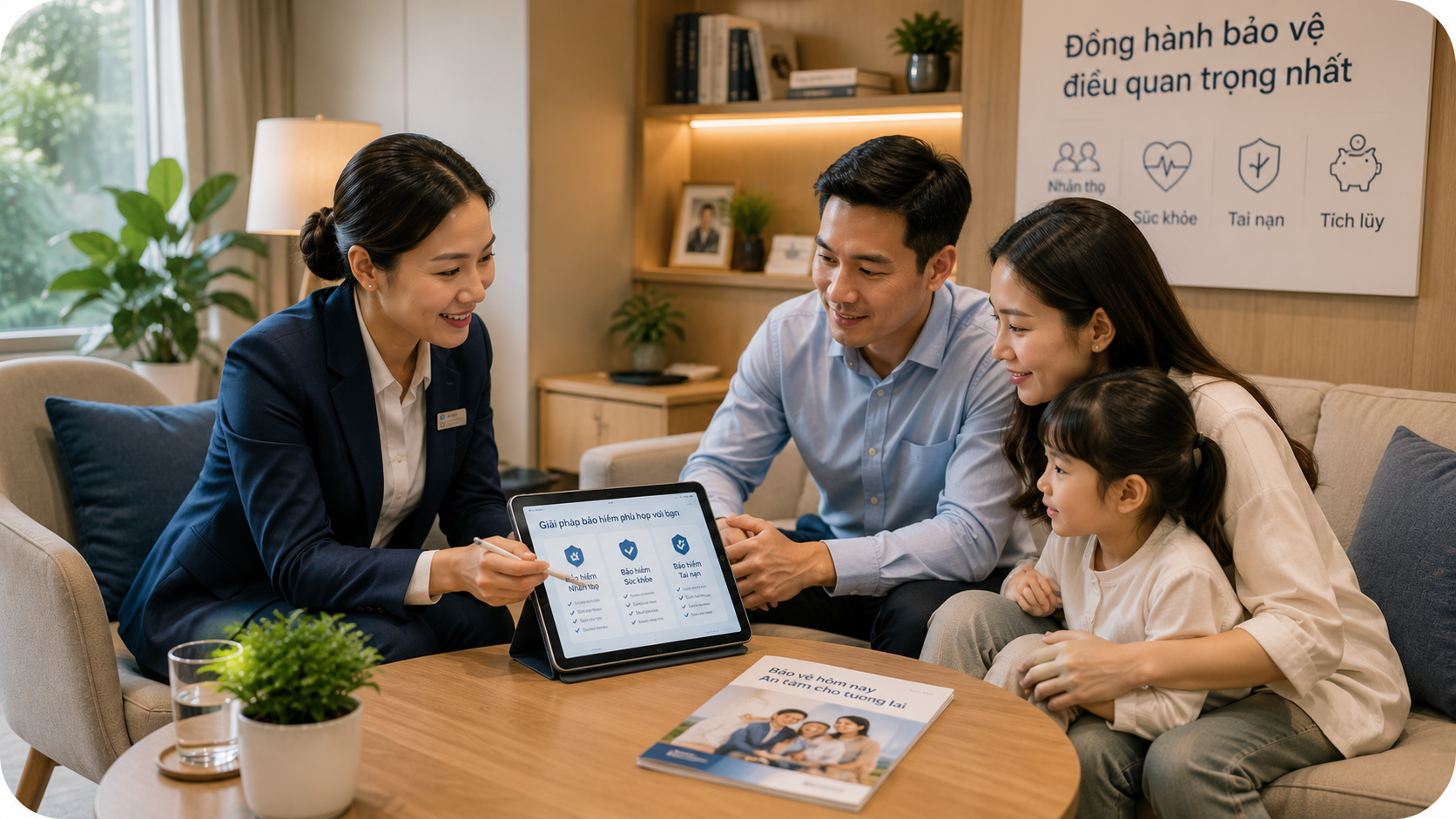
Mystery shopping helps insurers understand whether that is happening in practice.
Where mystery shopping creates value
Insurance programmes typically focus on the quality of customer conversations rather than simply monitoring sales activity.
Mystery shopping can help insurers evaluate:
- How effectively advisers identify customer needs.
- Whether policy benefits and exclusions are explained clearly.
- The quality of recommendations across agency, bancassurance and digital channels.
- The consistency of customer experiences across different distribution partners.
- Claims enquiries and customer support interactions.
- Competitor sales approaches and customer journeys.
These insights help organisations improve customer confidence while supporting responsible selling and operational consistency.
Market perspective
In Vietnam, the insurance industry has faced increased scrutiny of bancassurance practices in recent years, underscoring the importance of clear communication and appropriate product recommendations. Mystery shopping provides independent evidence of whether customer conversations meet organisational standards and support informed decision-making.
A broad mix of agency networks, bancassurance partnerships and digital distribution characterises Indonesia’s insurance market. As these channels continue to evolve, insurers increasingly need to evaluate whether customers receive consistent information and service regardless of how they engage.
For both markets, mystery shopping supports stronger governance while helping insurers build long-term customer trust.
Cimigo insight
Customer trust cannot be measured solely by operational metrics. Combining mystery shopping with consumer research provides a deeper understanding of purchasing behaviour, confidence and changing expectations.
Mystery shopping helps evaluate the quality of customer conversations. Understanding customer trust, insurance needs and purchasing behaviour provides valuable context for interpreting those observations.
Related Cimigo research:
Segmenting Vietnam’s Life Insurance Market – six customer segments, trust drivers and customer experience preferences.
The Informed Consumer Era – how Indonesian consumers increasingly research and compare financial products before making decisions.
Mystery shopping for automotive
The challenge
The dealership is no longer the beginning of the customer journey.
Most buyers now arrive having researched vehicles online, compared specifications, watched reviews and explored financing options before speaking with a sales consultant.
For manufacturers and dealer groups, this means customer experience must be consistent across digital and physical channels while supporting increasingly informed purchasing decisions.
The transition towards electric vehicles adds another layer of complexity, requiring dealerships to provide knowledgeable advice on charging, ownership costs and new technologies.
Where mystery shopping creates value
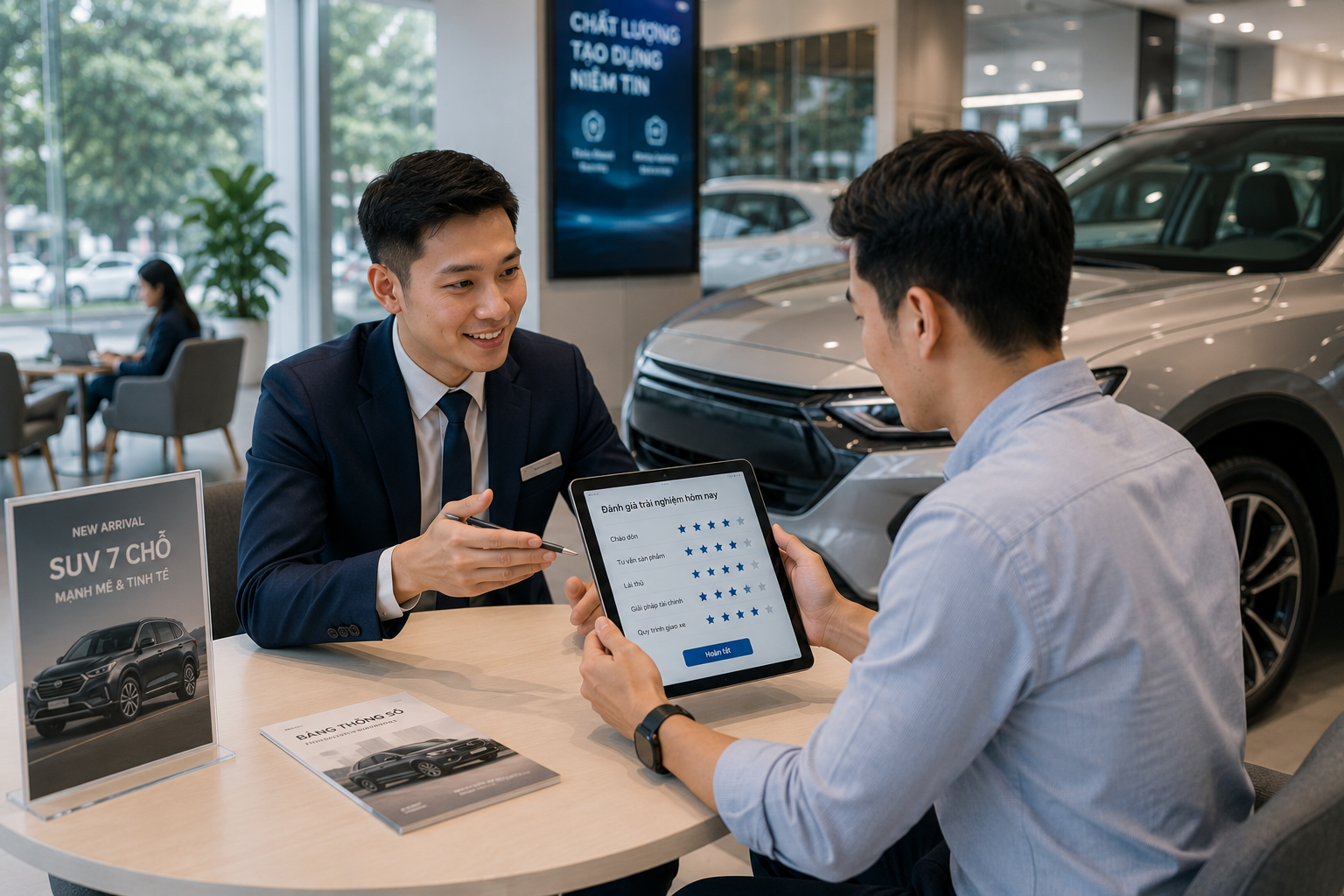
Mystery shopping helps manufacturers and dealer networks evaluate how effectively dealerships guide customers from initial enquiry through to long-term ownership.
Typical programmes assess:
- Online enquiry handling and lead response.
- Vehicle demonstrations and test drives.
- Finance and ownership discussions.
- Electric vehicle consultations.
- Vehicle handover.
- After-sales service and maintenance.
- Consistency across dealer networks.
- Competitor showroom experiences.
Rather than focusing solely on sales conversion, mystery shopping helps identify the behaviours that encourage customer confidence and strengthen brand loyalty.
Market perspective
Vietnam’s automotive market continues to evolve rapidly as interest in electric vehicles and digital retailing grows. Customers increasingly expect dealerships to provide consultative advice rather than simply product information.
Indonesia’s larger and geographically dispersed dealer networks create different priorities. Operational consistency, service quality and effective dealer management become essential for protecting the customer experience across multiple regions.
Mystery shopping provides manufacturers with a consistent framework for evaluating diverse customer journeys while accounting for local market conditions.
Cimigo insight
Customer experience is influenced by more than the dealership visit. Broader research into mobility, ownership preferences and brand perceptions helps explain why purchasing behaviours are changing.
Mystery shopping for quick service restaurants (QSR)
The challenge
In quick service restaurants, consistency is the product.
Customers expect the same quality of food, speed of service and brand experience whether they visit a flagship restaurant, a franchised outlet or place an order through a delivery app.
Maintaining that consistency across hundreds of locations, franchise partners, and digital channels is one of the industry’s greatest operational challenges.
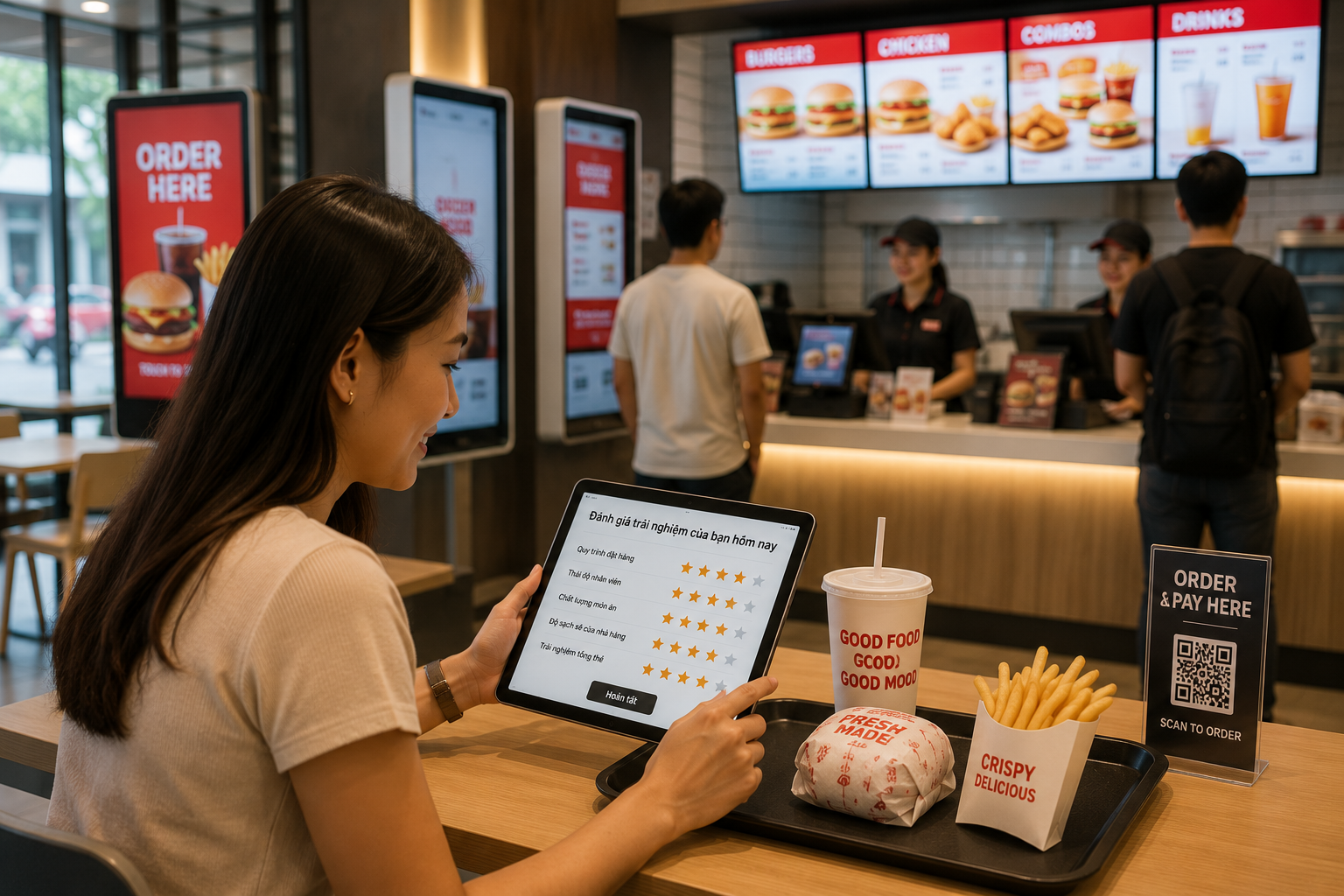
Where mystery shopping creates value
This enables restaurant operators to evaluate how customers experience the brand across every touchpoint.
Typical applications include:
- Speed of service.
- Order accuracy.
- Staff engagement and hospitality.
- Restaurant presentation and cleanliness.
- Drive-through operations.
- Mobile ordering.
- Delivery collection.
- Loyalty programme execution.
- Competitor benchmarking.
The objective is not simply to identify operational failures but to understand how daily interactions influence customer satisfaction, repeat visits and brand loyalty.
Market perspective
Vietnam’s restaurant sector continues to evolve as café culture, convenience and digital ordering reshape customer expectations. Customers increasingly move between dine-in, takeaway and app-based ordering, making consistency across channels a growing priority.
Indonesia’s extensive franchise networks and highly competitive food delivery marketplace place similar demands on restaurant operators. Customers often experience the brand digitally before entering a restaurant, making omnichannel execution an important source of competitive advantage. Our research into modern mobile cafes demonstrates the dynamism of Indonesia’s café culture.
This helps organisations evaluate whether operational standards translate into consistently positive customer experiences.
Cimigo insight
Restaurant performance should be considered alongside broader research into changing dining habits, convenience and digital behaviour.
Vietnam Retail Trends – changing shopping habits, digital commerce and evolving retail formats.
Indonesia’s Modern Mobile Café – how convenience and mobility are changing food and beverage consumption.
Digital and omnichannel mystery shopping
The challenge
Today’s customers don’t think in channels.
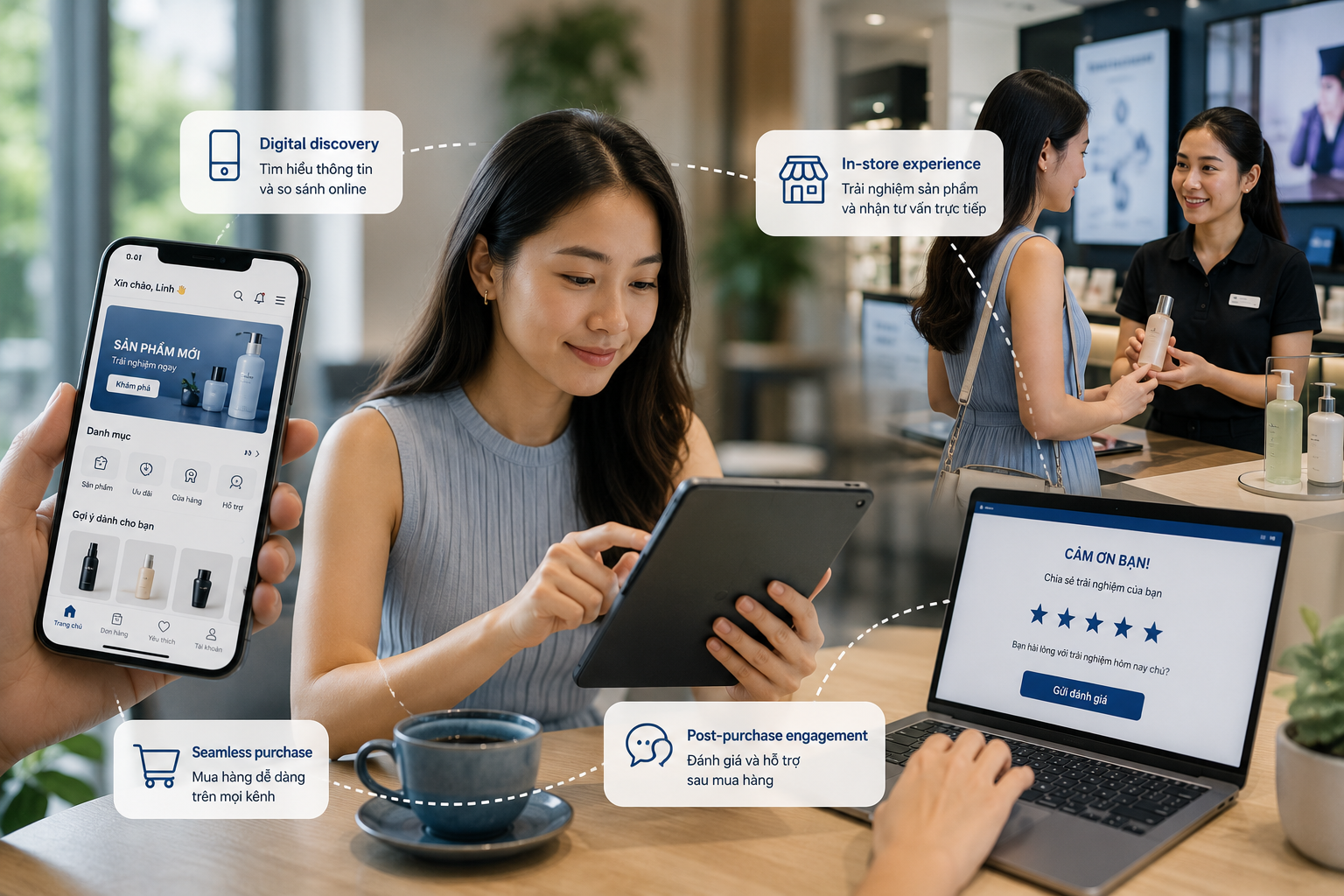
They might discover a brand through Google, compare products on a mobile phone, ask questions via WhatsApp or Zalo, visit a branch or showroom, and complete their purchase online. From the customer’s perspective, it’s one continuous journey.
Unfortunately, many organisations still manage these channels independently. Marketing, digital, contact centres and frontline teams often work to different objectives, creating fragmented customer experiences.
As digital transformation accelerates across Vietnam and Indonesia, ensuring consistency across every touchpoint has become a competitive advantage rather than simply an operational objective.
Where mystery shopping creates value
Digital mystery shopping evaluates how effectively organisations deliver connected customer experiences across multiple channels.
Typical programmes assess:
- Website usability and navigation.
- Online enquiry handling.
- Live chat and chatbot interactions.
- WhatsApp, Zalo and social messaging.
- Mobile application usability.
- Contact centre responsiveness.
- Appointment booking.
- Follow-up communications.
- Transitions between digital and physical channels.
The objective is not to score individual channels independently, but to understand whether customers experience a coherent brand regardless of how they engage.
For organisations investing in AI, automation and self-service technologies, mystery shopping also provides valuable evidence of where technology enhances the customer experience, and where human intervention remains essential.
Market perspective
Vietnam and Indonesia continue to experience rapid digital adoption, although customer journeys differ between industries and customer segments.
In Vietnam, messaging platforms such as Zalo have become an important customer service channel alongside websites and mobile applications. In Indonesia, WhatsApp often plays a central role in customer communication across banking, retail and automotive sectors.
Understanding how these digital interactions connect with physical experiences is becoming just as important as evaluating individual branches or stores.
Cimigo insight
Digital customer journeys continue to evolve rapidly. Mystery shopping explains how customers experience those journeys, while broader consumer research helps organisations understand changing digital behaviours and channel preferences.
As customers increasingly move between websites, messaging platforms and physical stores, organisations need to evaluate the complete omnichannel journey.
Related Cimigo research:
Vietnam online shopping – how digital behaviours continue to reshape customer expectations.
Vietnam Retail Trends – changing shopping habits, digital commerce and evolving retail formats.
The Informed Consumer Era – Indonesian fintech adoption and changing digital expectations.
Competitor mystery shopping
The challenge
Most organisations measure themselves against internal standards.
Customers do not.
A customer comparing two banks, two dealerships or two restaurant brands is influenced by the best experience they receive, not by an organisation’s internal KPIs.
Without understanding competitor performance, businesses risk improving internally while still falling behind the market.

Where mystery shopping creates value
Competitor analysis provides an independent benchmark against the organisations that matter most.
Rather than simply comparing service scores, it helps answer strategic questions such as:
- Why do competitors convert more enquiries into sales?
- How do market leaders build customer confidence?
- Which customer experiences differentiate premium brands?
- How effectively are competitors integrating digital and physical channels?
- What emerging service practices are changing customer expectations?
These insights often provide more strategic value than internal benchmarking alone because they reveal what customers are likely to experience elsewhere.
Competitor mystery shopping is particularly valuable before launching new customer experience initiatives, redesigning sales processes or investing in digital transformation.
Market perspective
Competition continues to intensify across Vietnam and Indonesia as domestic and international brands invest in customer experience.
Benchmarking competitors helps organisations distinguish between internal assumptions and genuine market leadership. It also enables investment decisions to be based on evidence rather than perception.
Cimigo insight
Competitor benchmarking is most valuable when combined with broader market research, brand tracking and consumer insights. Understanding what competitors do is important; understanding why customers choose them is even more valuable.
Explore related market and industry analysis through AskCimigo.
Choosing the right mystery shopping research partner
Selecting a mystery shopping partner involves far more than comparing costs or fieldwork coverage.
The quality of a mystery shopping programme depends on the research design, the realism of customer scenarios, the consistency of field execution and, most importantly, the ability to translate observations into practical business recommendations.
When evaluating a research partner, organisations should consider several key questions.
Do they understand your industry?
Customer journeys differ significantly between banking, insurance, automotive, retail and hospitality. Effective mystery shopping requires realistic scenarios that reflect the commercial and operational challenges of each sector.
Do they understand local markets?
Customer expectations vary between countries, regions and even cities. Local researchers, local language capability and cultural understanding produce more meaningful insights than standardised global approaches.
Can they evaluate modern customer journeys?
Today’s customer experiences extend well beyond physical visits. Effective programmes should assess websites, mobile applications, messaging platforms, contact centres, and in-person interactions as a single connected journey.
Can they turn research into action?
The greatest value comes from interpretation rather than measurement alone.
A good research partner identifies patterns, explains why performance differs between locations and recommends practical improvements that support better business decisions.
At Cimigo, mystery shopping is rarely delivered as a standalone project. It is typically integrated with customer satisfaction research, Voice of Customer programmes, customer journey mapping and broader market research. Together, these methodologies help organisations understand not only what customers experience, but the drivers behind those experiences.
Cimigo insight
Good mystery shopping measures performance. Great mystery shopping informs decisions. The difference lies in thoughtful research design, meaningful analysis and actionable recommendations.
From measurement to continuous improvement
Mystery shopping has evolved significantly over the past two decades. What began primarily as a way to monitor service standards is now recognised as an important component of customer experience strategy.
Leading organisations no longer use mystery shopping to identify operational failures or produce league tables. Instead, they use it to understand customer journeys, benchmark competitors, strengthen employee coaching and evaluate the impact of business improvements over time.
For organisations operating in Vietnam and Indonesia, this broader perspective is particularly valuable. Consumer expectations continue to evolve, digital channels are reshaping how customers engage with brands, and competition is becoming increasingly centred on experience rather than price alone.
Well-designed mystery shopping programmes provide objective evidence that helps organisations adapt to these changes with confidence. Most importantly, mystery shopping should not be viewed as an end in itself. It is one part of a broader evidence base that supports better decisions.
When interpreted alongside customer satisfaction research, Voice of Customer programmes, customer journey mapping and market research, it helps organisations move beyond measuring service performance to understanding how customer experiences influence loyalty, trust and long-term business success.
At Cimigo, the purpose of research is not simply to measure performance. It is to generate insights that help organisations improve customer experiences, strengthen commercial outcomes and make better decisions. Whether your objective is to improve branch service, optimise dealership performance, strengthen insurance advice or deliver greater consistency across restaurant networks, the first step is always the same: Understand what your customers actually experience. Everything else starts there.
Frequently asked questions
What is mystery shopping?
Mystery shopping is a market research methodology in which trained researchers anonymously evaluate customer interactions using predefined scenarios and evaluation criteria.
What is the purpose of mystery shopping?
Mystery shopping helps organisations understand how customers actually experience their products, services, and employees, enabling them to improve customer experience and operational performance.
What industries use mystery shopping?
Mystery shopping is widely used in:
- Banking.
- Insurance.
- Automotive.
- Retail.
- Hospitality.
- Quick service restaurants.
- Healthcare.
- Telecommunications.
- Property.
- Consumer services.
What is the difference between mystery shopping and customer satisfaction research?
Customer satisfaction research measures how customers feel after an interaction.
Mystery shopping measures what objectively happened during that interaction.
Both methodologies answer different business questions and are often most valuable when used together.
Can mystery shopping evaluate digital channels?
Yes. Modern mystery shopping programmes commonly evaluate:
- Websites.
- Mobile apps.
- Live chat.
- WhatsApp.
- Zalo.
- Contact centres.
- Social messaging.
- Omnichannel journeys.
Can mystery shopping benchmark competitors?
Yes. Competitor mystery shopping compares customer experiences across competing organisations, helping businesses identify strengths, weaknesses and emerging best practices.
How often should mystery shopping be conducted?
Most organisations conduct programmes quarterly or continuously, depending on business objectives, seasonality and operational change.
How many mystery shopping visits are required?
There is no fixed number. Sample sizes depend on:
- Number of locations
- Customer segments
- Business objectives
- Statistical confidence required
- Budget
However, if you are new to mystery shopping, start small, optimise, and then scale once the insights prove valuable to your business.
Is mystery shopping ethical?
Yes. Professional mystery shopping follows recognised research ethics, protects confidentiality and is designed to improve organisational performance rather than monitor individuals unfairly.
Why is local expertise important?
Customer expectations differ between countries, industries and cultures. Local researchers understand language, behaviours and market expectations, producing more meaningful insights than standardised international programmes.
How do I choose a mystery shopping agency?
Choose a research partner that offers:
- Strong research design.
- Industry expertise.
- Local market knowledge.
- Digital capability.
- Actionable reporting.
- Integration with broader customer research.
How can Cimigo help?
Cimigo designs customised mystery shopping programmes across Vietnam and Indonesia, integrating mystery shopping with customer satisfaction research, Voice of Customer programmes, customer journey mapping and broader market research to help organisations make better business decisions.