Visit AskCimigo and interrogate our reports with our AI assistant.
Indonesia’s economic outlook Q4 2025
Apr 04, 2026
Indonesia concluded 2025 with steady economic growth and resilient underlying fundamentals,

Vietnam consumer trends 2026
 Richard Burrage
 Feb 05, 2026
Vietnam is still a growth market, but consumer trends 2026 show that it has matured faster than most brands’ strategies. The result is margin pressure, slower conversion, and underperformance against plan.
This article is based on the Vietnam Consumer Trends 2026 report from Cimigo.
Growth in Vietnam now depends on precision, channel mastery, and defensible value, not optimism.
Why caution, channel fragmentation, and value pressure are reshaping consumer, retail, and marketing strategy?
Vietnam is still widely described as one of Asia’s most attractive consumer growth markets. Rising incomes, a large population, and rapid urbanisation continue to underpin long-term opportunity. Yet many brands and retailers are struggling to translate this macro promise into near-term performance.
The reason is not a weakening demand. It is a behavioural and structural change.
Vietnam’s GDP per capita reached approximately US$4,900 in 2025, yet consumer behaviour increasingly resembles that of far more mature markets.
Vietnamese consumers are still spending, but with greater caution, higher expectations for value, and far less tolerance for friction or disappointment. For brands, the era of easy growth has ended.
Vietnam’s consumers have entered a new psychological phase. Rising incomes have not produced carefree spending. Instead, households are becoming more deliberate, more selective, and more risk-aware.
Consumers are delaying big-ticket purchases, scrutinising price–value trade-offs, and prioritising flexibility over commitment. Even traditionally exuberant spending moments, such as Tết, have become more restrained and practical.
Aspiration still matters, but it must now be justified. Desire alone rarely converts.
For brands built on emotional uplift or premium promise, this represents a structural challenge, not a cyclical one.
Income growth is real. Confidence is not keeping pace.
Healthcare and education costs, income volatility, rapid formalisation, and lingering COVID-19 scarring have altered how households evaluate risk. Consumers are less willing to commit to large or discretionary purchases unless the perceived downside is low.
Consumer sentiment remains below pre-2019 levels, even as household affluence expands.
The commercial consequence is visible across categories:
For marketing teams, this means that brands must reduce perceived risk, not just increase desire.
Vietnam consumer trends 2026 point to a retail landscape that has crossed a structural threshold.
Modern trade and e-commerce now account for approximately 44% of retail sales, up from a near-zero modern trade share in the early 2000s.
Traditional trade still matters, but its dominance is fading. Modern minimarkets, convenience stores, pharmacies, and e-commerce platforms are expanding aggressively, reshaping availability, pricing, and shopper expectations.
Modern trade’s share of retail sales has grown from ~15% in 2005 to ~32% in 2025. E-commerce now accounts for ~12% of retail goods sales.
This fragmentation weakens pricing power and intensifies promotion-driven competition. Brands no longer control the shelf; platforms and retailers increasingly do.
Distribution visibility is as important as brand equity.
Digital commerce is no longer a side channel. It is the primary arena where discovery, evaluation, and conversion increasingly occur.
80% of online shoppers prefer purchasing via major e-commerce platforms, while 63% engage in livestream shopping and 53% use shoppable videos.
Livestreaming and social commerce blur the lines between entertainment and retail. They reward immediacy, promotion, and authenticity, often at the expense of long-term brand storytelling.
Marketing effectiveness is now inseparable from platform fluency. If your brand does not win in the feed, it rarely wins in the cart.
Vietnam consumer trends 2026 show that consumers are not abandoning brands. They are re-evaluating which brands are worth it.
Consumer finance now accounts for approximately 26% of GDP and ~58% of retail sales, highlighting both purchasing power and financial sensitivity.
Price sensitivity has increased, promotions have become permanent, and private labels and challenger brands are gaining share. Premiumisation strategies are stalling in many categories unless value is clearly articulated.
Brand margins are now defended, not assumed.
While goods volumes are flattening, consumer spending is reallocating toward services and experiences.
Services are growing faster than goods, with experiences increasingly absorbing incremental household spend.
Travel, leisure, convenience, and personal services are benefiting from the shift in Vietnam consumer trends 2026. For product-led brands, growth increasingly depends on layering experiences, services, or ecosystems around physical goods.
Growth is moving from ownership to usage, from products to moments.
The implications for CMOs and commercial leaders are uncomfortable but clear:
Annual planning cycles, static portfolio roles, and one-size-fits-all messaging are increasingly misaligned with consumer reality. Winning in Vietnam’s next consumer phase requires sharper choices:
These are not defensive moves. They are the cost of staying competitive in a maturing market.
Vietnam’s consumer growth story has not weakened. It has matured faster than many brands expected.
The next phase of growth will reward precision, relevance, and execution, not optimism. Brands that continue to rely on old playbooks will experience Vietnam as a margin squeeze and a demand puzzle. Brands that adapt will find a market that still rewards commitment, but only when it is earned.

Get instant access to syndicated consumer insights, market trends, and competitive intelligence across Vietnam.
If you have any questions or specific needs, please get in touch with us at ask@cimigo.com.

Indonesia’s economic outlook Q4 2025
Apr 04, 2026
Indonesia concluded 2025 with steady economic growth and resilient underlying fundamentals,
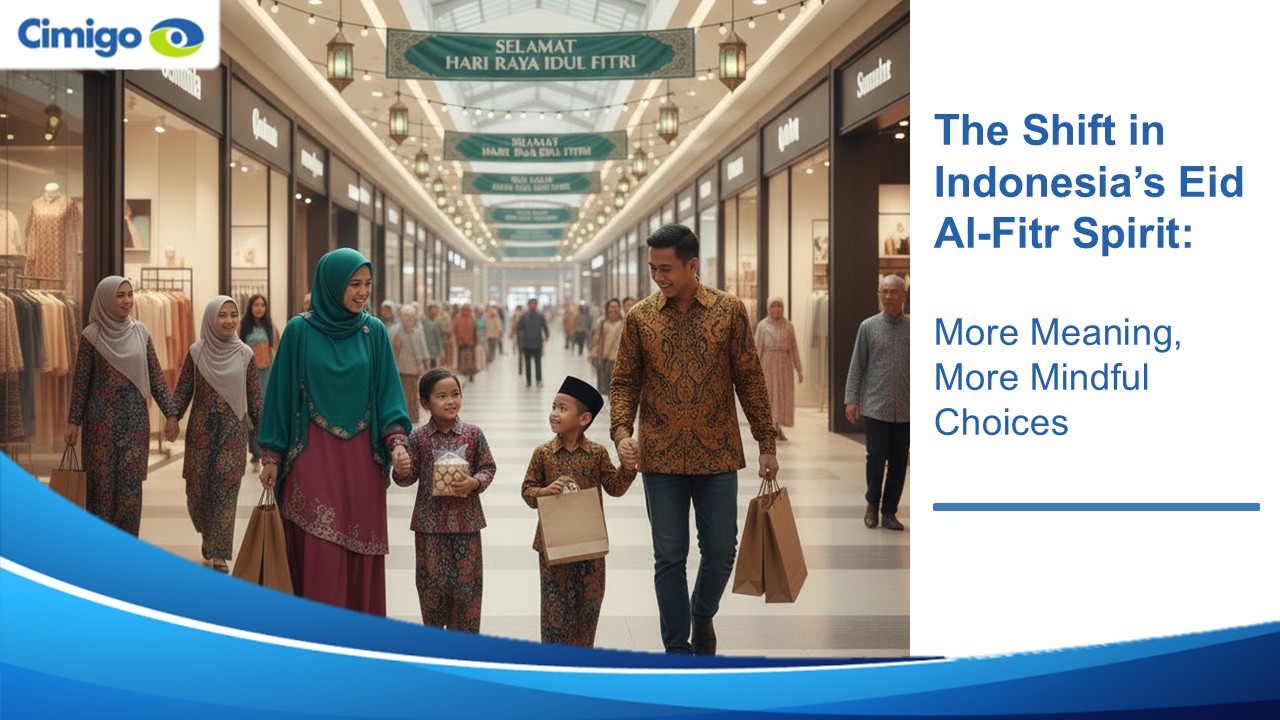
The shift in Indonesia’s Eid Al-Fitr Spirit: More Meaning, More Mindful Choices
Feb 24, 2026
Indonesia’s Eid Al-Fitr consumer landscape Ramadan and Eid al-Fitr are the main drivers of
Consumer Insights Vietnam: Why Opinions Aren’t Enough
Feb 23, 2026
Every marketer knows the moment: a tight deadline, a high-stakes decision, and no fresh data on
Đoàn Ngọc Huy (Johnny Doan), CMO & Market Research Expert -
As a Marketing Director and Market Research Expert Advisor across international markets, I have collaborated with numerous market research agencies, both global and local, that operate with a high level of professionalism and effectiveness. Cimigo is among the most outstanding. The Cimigo team demonstrates exceptional professionalism, strong commitment, and operational excellence. From research design and fieldwork execution to insight analysis, all stages are conducted rigorously, delivered on schedule, and closely aligned with business objectives. This is a highly capable team that I would confidently recommend to my partners and stakeholders.
As a Marketing Director and Market Research Expert Advisor across international markets, I have collaborated with numerous market research agencies, both global and local, that operate with a high level of professionalism and effectiveness. Cimigo is among the most outstanding. The Cimigo team demonstrates exceptional professionalism, strong commitment, and operational excellence. From research design and fieldwork execution to insight analysis, all stages are conducted rigorously, delivered on schedule, and closely aligned with business objectives. This is a highly capable team that I would confidently recommend to my partners and stakeholders.

Lisa Nguyen - Vietnam Marketing Lead
Mark Ratcliff - Managing Director
The team at Cimigo are my favourite researchers in South East Asia. They’ve proved adept at tackling the most private and complex personal issues at qualitative research level, not flinching when the client endlessly chopped and changed fieldwork timing, or ramped up the workload without warning. They have recruited the most extraordinarily niche consumers without pause or complaint. Their patience with clients and their flexibility and hard work that went above and beyond what was initially asked of them on two projects relating to sexual behaviour means there is now no other research company we would choose to work with in that part of Asia. The fact they also pulled off a third project for us so well, on men’s relationship with beer and beer advertising, shows they have breadth of expertise— we still quote from the report they produced.
The team at Cimigo are my favourite researchers in South East Asia. They’ve proved adept at tackling the most private and complex personal issues at qualitative research level, not flinching when the client endlessly chopped and changed fieldwork timing, or ramped up the workload without warning. They have recruited the most extraordinarily niche consumers without pause or complaint. Their patience with clients and their flexibility and hard work that went above and beyond what was initially asked of them on two projects relating to sexual behaviour means there is now no other research company we would choose to work with in that part of Asia. The fact they also pulled off a third project for us so well, on men’s relationship with beer and beer advertising, shows they have breadth of expertise— we still quote from the report they produced.
Kevin McQuillan - Chief Marketing Officer

Sam Houston - Chief Executive Officer

Minh Thu - Consumer Market Insights Manager
Travis Mitchell - Executive Director

Malcolm Farmer - Managing Director
Hy Vu - Head of Research Department

Joe Nelson - New Zealand Consulate General
Steve Kretschmer - Executive Director
York Spencer - Global Marketing Director

Laura Baines - Programmes Snr Manager
Mai Trang - Brand Manager of Romano

Hanh Dang - Product Marketing Manager
Luan Nguyen - Market Research Team Leader
Max Lee - Project Manager

Chris Elkin - Founder
Ronald Reagan - Deputy Group Head After Sales & CS Operation
Chad Ovel - Partner

Private English Language Schools - Chief Executive Officer
Rick Reid - Creative Director

Anya Nipper - Project Coordination Director

Dr. Jean-Marcel Guillon - Chief Executive Officer
Joyce - Pricing Manager

Matt Thwaites - Commercial Director
Aashish Kapoor - Head of Marketing

Kelly Vo - Founder & Host
Thanyachat Auttanukune - Board of Management
Hamish Glendinning - Business Lead

Thuy Le - Consumer Insight Manager
Richard Willis - Director

Ha Dinh - Project Lead
Geert Heestermans - Marketing Director

Vo Thi Thuy Ha - Commercial Effectiveness

Louise Knox - Consumer Technical Insights
Aimee Shear - Senior Research Executive

Dennis Kurnia - Head of Consumer Insights
Tania Desela - Senior Product Manager
Thu Phung - CTI Manager
Linda Yeoh - CMI Manager

 Team
Team
Cimigo’s market research team in Vietnam and Indonesia love to help you make better choices.
 Solutions
Cimigo provides market research solutions in Vietnam and Indonesia that will help you make better choices.
 Trends
Cimigo provides a range of consumer marketing trends and market research on market sectors and consumer segments in Vietnam and Indonesia.
 Reports
Cimigo provides a range of free market research reports on market sectors and consumer segments in Vietnam and Indonesia.